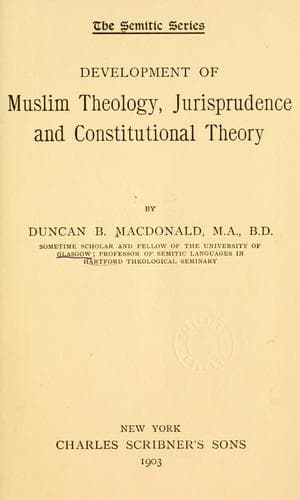
Development of Muslim Theology, Jurisprudence, and Constitutional TheoryMacDonald, Duncan Black
ReligionIslamic
Development of Muslim Theology, Jurisprudence, and Constitutional Theory
MacDonald, Duncan Black
Constitutional law (Islamic law); Islam -- Doctrines -- History; Islam and state -- History; Islamic law -- History
by his successor, al-Mu‘tasim, and by his successor, al-Wathiq, but
without energy; it was more a handy political weapon than anything else.
In 234, the second year of al-Mutawakkil, it was abolished and the Qur’an
decreed uncreated. At the same time the Alids and all Persian nationalism
came under a ban. Practically, the _status quo ante_ was restored and
Mu‘tazilism was again left a struggling heresy. The Arab party and the
pure faith of Muhammad had reasserted themselves.
[Sidenote: AHMAD IBN HANBAL]
In this long conflict, the most prominent figure was certainly that of
Ahmad ibn Hanbal. He was the trust and strength of the orthodox; that he
stood fast through imprisonment and scourging defeated the plans of the
Mu‘tazilites. In dealing with the development of law, we have seen what
his legal position was. The same held in theology. Scholastic theology
(_kalam_) was his abomination. Those who disputed over doctrines he cast
out. That their dogmatic position was the same as his made no difference.
For him, theological truth could not be reached by reasoning (_aql_);
tradition (_naql_) from the fathers (_as-salaf_) was the only ground on
which the dubious words of the Qur’an could be explained. So, in his
long examinations before the officials of al-Ma‘mun and al-Mu‘tasim, he
contented himself with repeating either the words of the Qur’an which
for him were proofs or such traditions as he accepted. Any approach to
drawing a consequence he utterly rejected. When they argued before him,
he kept silence.
What, then, we may ask, was the net result of this incident? for it was
nothing more. The Mu‘tazilites dropped back into their former position,
but under changed conditions. The sympathy of the populace was further
from them than ever. Ahmad ibn Hanbal, saint and ascetic, was the idol
of the masses; and he, in their eyes, had maintained single-handed the
honor of the Word of God. For his persecutors there was nothing but
hatred. And after he had passed away, the conflict was taken up with
still fiercer bitterness by the school of law founded by his pupils. They
continued to maintain his principles of Qur’an and tradition long after
the Mu‘tazilites themselves had practically vanished from the scene, and
all that was left for them to contend against was the modified system of
scholastic theology which is now the orthodox theology of Islam. With
these reactionary Hanbalites we shall have to deal later.
[Sidenote: SCHOOLS OF MU‘TAZILITES]
Public-domain text, read in full here on John Shaqi.
Reviews
Reviews
No reviews yet
Be the first to share your thoughts on this work.
Elsewhere in the archive
Join the Discussion
Join the discussion
Sign in to leave a comment or review.
Sign InorCreate an account