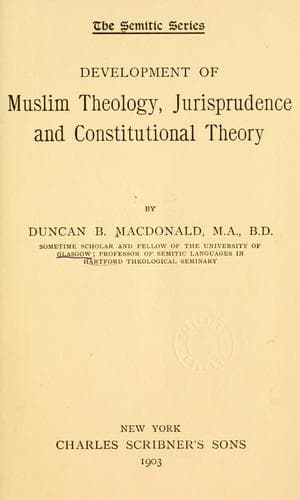
Development of Muslim Theology, Jurisprudence, and Constitutional TheoryMacDonald, Duncan Black
ReligionIslamic
Development of Muslim Theology, Jurisprudence, and Constitutional Theory
MacDonald, Duncan Black
Constitutional law (Islamic law); Islam -- Doctrines -- History; Islam and state -- History; Islamic law -- History
The Mu‘tazilites, on their side, having seen the shipwreck of their
hopes and the growing storm of popular disfavor, seem to have turned
again to their scholastic studies. They became more and more theologians
affecting a narrower circle, and less and less educators of the world
at large. Their system became more metaphysical and their conclusions
more unintelligible to the plain man. The fate which has fallen on all
continued efforts of the Muslim mind was coming upon them. Beggarly
speculations and barren hypotheses, combats of words over names, sapped
them of life and reality. What the ill-fated friendship of al-Ma’mun had
begun was carried on and out by the closed circle of Muslim thought.
They separated into schools, one at al-Basra and another at Baghdad. At
Baghdad the point especially developed was the old question, What is a
thing (_shay_)? They defined a thing, practically, as a concept that
could be known and of which something could be said. Existence (_wujud_)
did not matter. It was only a quality which could be there or not.
With it, the thing was an entity (_mawjud_); without it, a non-entity
(_ma‘dum_), but still a thing with all equipment of substance (_jawhar_)
and accident (_arad_), genus and species. The bearing of this was
especially upon the doctrine of creation. Practically, by God’s adding
a single quality, things entered the sphere of existence and _were_ for
us. Here, then, is evidently an approach to a doctrine of pre-existent
matter. At al-Basra the relation of God to His qualities was especially
discussed, and there it came to be pretty nearly a family dispute between
al-Jubba‘i (d. 303) and his son Abu Hashim. Orthodox Islam held that
God has qualities, existent, eternal, added to His essence; thus, He
knows, for example, by such a quality of knowledge. The students of Greek
philosophy and the Shi‘ites denied this and said that God knew by His
essence. We have seen already Mu‘tazilite views as to this point. Abu
Hudhayl held that these qualities _were_ God’s essence and not _in_ it.
Thus, He knew by a quality of knowledge, but that quality _was_ His
essence. Al-Jubba‘i contented himself with safeguarding this statement.
God knew in accordance with His essence, but it was neither a quality nor
a state (_hal_) which required that He should be a knower. The orthodox
had said the first; his son, Abu Hashim, said the second. He held that we
know an essence and know it under different conditions. The conditions
varied but the essence remained. These conditions are not thinkable by
themselves, for we know them only in connection with the essence. These
are states; they are different from the essence, but do not exist apart
from it. Al-Jubba‘i opposed to this a doctrine that these states were
really subjective in the mind of the perceiver, either generalizations
or relationships existing mentally but not externally. This controversy
spun itself out at great length through centuries. It eventually
Public-domain text, read in full here on John Shaqi.
Reviews
Reviews
No reviews yet
Be the first to share your thoughts on this work.
Elsewhere in the archive
Join the Discussion
Join the discussion
Sign in to leave a comment or review.
Sign InorCreate an account