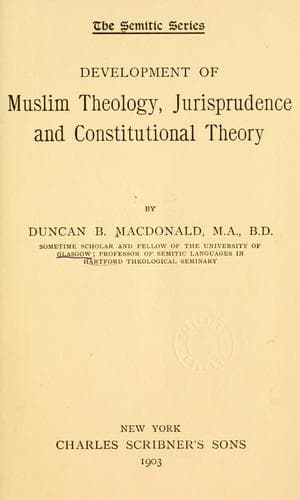
Development of Muslim Theology, Jurisprudence, and Constitutional TheoryMacDonald, Duncan Black
ReligionIslamic
Development of Muslim Theology, Jurisprudence, and Constitutional Theory
MacDonald, Duncan Black
Constitutional law (Islamic law); Islam -- Doctrines -- History; Islam and state -- History; Islamic law -- History
resolved itself into the fundamental metaphysical inquiry, What is a
thing? A powerful school came to a conclusion that would have delighted
the soul of Mr. Herbert Spencer. Things are four, they said, entities,
non-entities, states and relationships. As we have seen above, al-Jubba‘i
denied the reality of both states and relationships. Orthodox Islam has
been of a divided opinion.
But all this time, other movements had been in progress, some of
which were to be of larger future importance than this fossilizing
intellectualism. In 255 al-Jahiz died. Though commonly reckoned a
Mu‘tazilite he was really a man of letters, free in life and thought. He
was a maker of books, learned in the writings of the philosophers and
rather inclined to the doctrines of the Tabi‘iyun, deistic naturalists.
His confession of faith was of the utmost simplicity. He taught that
whoever held that God had neither body nor form, could not be seen with
the eyes, was just and willed no evil deeds, such was a Muslim in truth.
And, further, if anyone was not capable of philosophical reflection, but
held that Allah was his Lord and that Muhammad was the Apostle of Allah,
he was blameless and nothing more should be required of him. Here we have
evidently in part a reaction from the subtilties of controversy, and in
part an attempt to broaden theology enough to give even the unsettled
a chance to remain in the Muslim Church. Something of the same kind we
shall find, later, in the case of Ibn Rushd. Finally, we have probably
to see in his remark that the Qur’an was a body, turned at one time into
a man and at another into a beast, a satirical comment on the great
controversy of his time.
[Sidenote: AL-JAHIZ; AL-KINDI]
Al-Jahiz may be for us a link with the philosophers proper, the students
of the wisdom of the Greeks. He represents the stand-point of the
educated man of the time, and was no specialist in anything but a general
scepticism. In the first generation of the philosophers of Islam, in
the narrower sense, stands conspicuously al-Kindi, commonly called the
Philosopher of the Arabs. The name belongs to him of right, for he is
almost the only example of a student of Aristotle, sprung from the
blood of the desert. But he was hardly a philosopher in any independent
sense. His rôle was translating, and during the reigns of al-Ma’mun
and al-Mu‘tasim a multitude of translations and original works _de omni
scibili_ came from his hands; the names of 265 of these have come down
to us. In the orthodox reaction under al-Mutawakkil he fared ill; his
library was confiscated but afterward restored. He died about 260, and
with him dies the brief, golden century of eager acquisition, and the
scholastic period enters in philosophy as in theology.
[Sidenote: PLATO; PLOTINUS; ARISTOTLE]
Public-domain text, read in full here on John Shaqi.
Reviews
Reviews
No reviews yet
Be the first to share your thoughts on this work.
Elsewhere in the archive
Join the Discussion
Join the discussion
Sign in to leave a comment or review.
Sign InorCreate an account