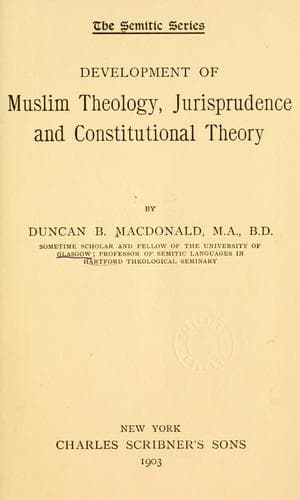
Development of Muslim Theology, Jurisprudence, and Constitutional TheoryMacDonald, Duncan Black
ReligionIslamic
Development of Muslim Theology, Jurisprudence, and Constitutional Theory
MacDonald, Duncan Black
Constitutional law (Islamic law); Islam -- Doctrines -- History; Islam and state -- History; Islamic law -- History
That the glory was departing from Baghdad and the Khalifate is shown by
the second important name in philosophy. It is that of al-Farabi, who
was born at Farab in Turkestan, lived and worked in the brilliant circle
which gathered round Sayf ad-Dawla, the Hamdanid, at his court at Aleppo.
In music, in science, in philology, and in philosophy, he was alike
master. Aristotle was his passion, and his Arabic contemporaries and
successors united in calling him the second teacher, on account of his
success in unknotting the tangles of the Greek system. It was in truth
a tangled system which came to him, and a tangled system which he left.
The Muslim philosophers began, in their innocence, with the following
positions: The Qur’an is truth and philosophy is truth; but truth can
only be one; therefore, the Qur’an and philosophy must agree. Philosophy
they accepted in whole-hearted faith, as it came to them from the Greeks
through Egypt and Syria. They took it, not as a mass of more or less
contradictory speculation, but as a form of truth. They, in fact, never
lost a certain theological attitude. Under such conditions, then, Plato
came to them; but it was mostly Plato as interpreted by Porphyrius,
that is, as neo-Platonism. Aristotle, too, came to them in the guise
of the later Peripatetic schools. But in Aristotle, especially, there
entered a perfect knot of entanglement and confusion. During the reign of
al-Mu‘tasim, a Christian of Emessa in the Lebanon—the history in details
is obscure—translated parts of the “Enneads” of Plotinus into Arabic
and entitled his work “The Theology of Aristotle.” A more unlucky bit
of literary mischief and one more far-reaching in its consequences has
never been. The Muslims took it all as solemnly as they took the text of
the Qur’an. These two great masters, Plato and Aristotle, they said, had
expounded the truth, which is one. Therefore, there must be some way of
bringing them into agreement. So generations of toilers labored valiantly
with the welter of translations and pseudographs to get out of them and
into them the one truth. The more pious added the third element of the
Qur’an, and it must remain a marvel and a magnificent testimonial to
their skill and patience that they got even so far as they did and that
the whole movement did not end in simple lunacy. That al-Farabi should
have been so incisive a writer, so wide a thinker and student; that Ibn
Sina should have been so keen and clear a scientist and logician; that
Ibn Rushd should have known—really known—and commented his Aristotle
as he did, shows that the human brain, after all, is a sane brain and
has the power of unconsciously rejecting and throwing out nonsense and
falsehood.
Public-domain text, read in full here on John Shaqi.
Reviews
Reviews
No reviews yet
Be the first to share your thoughts on this work.
Elsewhere in the archive
Join the Discussion
Join the discussion
Sign in to leave a comment or review.
Sign InorCreate an account