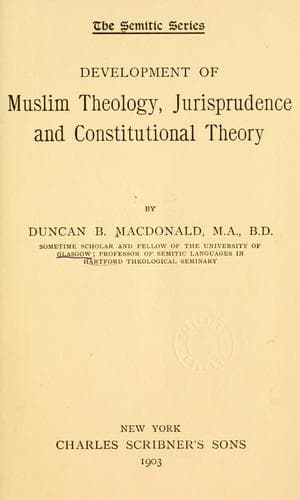
Development of Muslim Theology, Jurisprudence, and Constitutional TheoryMacDonald, Duncan Black
ReligionIslamic
Development of Muslim Theology, Jurisprudence, and Constitutional Theory
MacDonald, Duncan Black
Constitutional law (Islamic law); Islam -- Doctrines -- History; Islam and state -- History; Islamic law -- History
But it is not wonderful that, dealing with such materials and
contradictions, they developed a tendency to mysticism. There were many
things which they felt compelled to hold which could only be defended
and rationalized in that cloudy air and slanting light. Especially,
no one but a mystic could bring together the emanations of Plotinus,
the ideas of Plato, the spheres of Aristotle and the seven-storied
heaven of Muhammad. With this matter of mysticism we shall have to deal
immediately. Of al-Farabi it is enough to say that he was one of the most
patient of the laborers at that impossible problem. It seems never to
have occurred to him, or to any of the others, that the first and great
imperative was to verify his references and sources. The oriental, like
the mediæval scholastic, tests minutely the form of his syllogism, but
takes little thought whether his premises state facts or not. With a
scrupulous scepticism in deduction, he combines a childlike acceptance on
tradition or on the narrowest of inductions.
[Sidenote: AL-FARABI]
But there are other and more ominous signs in al-Farabi of the scholastic
decline. There appears first in him that tendency toward the writing
of encyclopædic compends, which always means superficiality and the
commonplace. Al-Farabi himself could not be accused of either, but
that he thus claimed all knowledge for his portion showed the risk of
the premature circle and the small gain. Another is mysticism. He is a
neo-Platonist, more exactly a Plotinian; although he himself would not
have recognized this title. He held, as we have seen, that he was simply
retelling the doctrines of Plato and Aristotle. But he was also a devout
Muslim. He seems to have taken in earnest all the bizarre details of
Muslim cosmography and eschatology; the Pen, the Tablet, the Throne, the
Angels in all their ranks and functions mingle picturesquely with the
system of Plotinus, his ἕν, his ψυχή, his νοῦς, his receptive and active
intellects. But to make tenable this position he had to take the great
leap of the mystic. Unto us these things are impossible; with God, i.e.,
on another plane of existence, they are the simplest realities. If the
veil were taken from our eyes we would see them. This has always been the
refuge of the devout Muslim who has tampered with science. We shall look
for it more in detail when we come to al-Ghazzali, who has put it into
classical form.
Public-domain text, read in full here on John Shaqi.
Reviews
Reviews
No reviews yet
Be the first to share your thoughts on this work.
Elsewhere in the archive
Join the Discussion
Join the discussion
Sign in to leave a comment or review.
Sign InorCreate an account