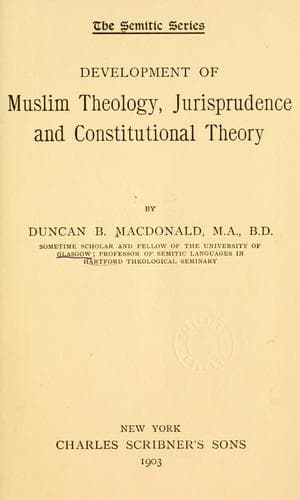
Development of Muslim Theology, Jurisprudence, and Constitutional TheoryMacDonald, Duncan Black
ReligionIslamic
Development of Muslim Theology, Jurisprudence, and Constitutional Theory
MacDonald, Duncan Black
Constitutional law (Islamic law); Islam -- Doctrines -- History; Islam and state -- History; Islamic law -- History
Again, he was, in modern terms, a monarchist and a clericalist. His
conception of the model state is a strange compound of the republic of
Plato and Shi‘ite dreams of an infallible Imam. Its roots lie, of course,
in the theocratic idea of the Muslim state; but his city, which is to
take in all mankind, a Holy Roman Empire and a Holy Catholic Church at
once, a community of saints ruled by sages, shows a later influence than
that of the mother city of Islam, al-Madina, under Abu Bakr and Umar.
The influence is that of the Fatimids with their capital, al-Mahdiya,
near Tunis. The Hamdanids were Shi‘ites and Sayf ad-Dawla, under whom
al-Farabi enjoyed peace and protection, was a vassal of the Fatimid
Khalifas.
This brings us again to the great mystery of Muslim history. What was the
truth of the Fatimid movement? Was the family of the Prophet the fosterer
of science from the earliest times? What degree of contact had they with
the Mu‘tazilites? With the founders of grammar, of alchemy, of law? That
they were themselves the actual beginners of everything—and everything
has been claimed for them—we may put down to legend. But one thing does
stand fast. Just as al-Ma’mun combined the establishment of a great
university at Baghdad with a favoring of the Alids, so the Fatimids in
Cairo erected a great hall of science and threw all their influence and
authority into the spreading and extending of knowledge. This institution
seems to have been a combination of free public library and university,
and was probably the gateway connecting between the inner circle of
initiated Fatimid leaders and the outside, uninitiated world. We have
already seen how unhappy were the external effects of the Shi‘ite, and
especially of the Fatimid, propaganda on the Muslim world. But from
time to time we become aware of a deep undercurrent of scientific and
philosophical labor and investigation accompanying that propaganda, and
striving after knowledge and truth. It belongs to the life below the
surface, which we can know only through its occasional outbursts. Some of
these are given above; others will follow. The whole matter is obscure
to the last degree, and dogmatic statements and explanations are not in
place. It may be that it was only a natural drawing together on the part
of all the different forces and movements that were under a ban and had
to live in secrecy and stillness. It may be that the students of the
new sciences passed over, simply through their studies and political
despair—as has often happened in our day—into different degrees of
nihilism, or, at the other extreme, into a passionate searching for, and
dependence on, some absolute guide, an infallible Imam. It may be that
we have read wrongly the whole history of the Fatimid movement; that it
was in reality a deeply laid and slowly ripened plan to bring the rule of
the world into the control of a band of philosophers, whose task it was
Public-domain text, read in full here on John Shaqi.
Reviews
Reviews
No reviews yet
Be the first to share your thoughts on this work.
Elsewhere in the archive
Join the Discussion
Join the discussion
Sign in to leave a comment or review.
Sign InorCreate an account