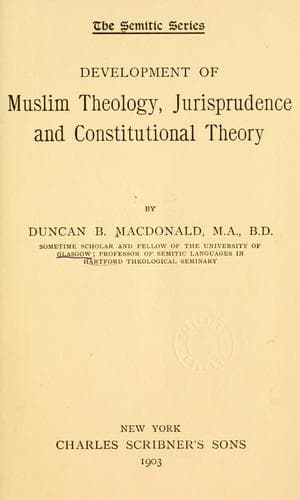
Development of Muslim Theology, Jurisprudence, and Constitutional TheoryMacDonald, Duncan Black
ReligionIslamic
Development of Muslim Theology, Jurisprudence, and Constitutional Theory
MacDonald, Duncan Black
Constitutional law (Islamic law); Islam -- Doctrines -- History; Islam and state -- History; Islamic law -- History
to be to rule the human race and gradually to educate it into self-rule;
that they saw—these unknown devotees of science and truth—no other way of
breaking down the barriers of Islam and setting free the spirits of men.
A wild hypothesis! But in face of the real mystery no hypothesis can seem
wild.
[Sidenote: IKHWAN AS-SAFA]
Closely allied with both al-Farabi and the Fatimids is the association
known as the Sincere Brethren (_Ikhwan as-safa_). It existed at al-Basra
in the middle of the fourth century of the Hijra during the breathing
space which the free intellectual life enjoyed after the capture of
Baghdad by the Buwayhids in 334. It will be remembered how that Persian
dynasty was Shi‘ite by creed and how it, for the time, completely clipped
the claws of the orthodox and Sunnite Abbasid Khalifas. The only thing,
thereafter, which heretics and philosophers had to fear was the enmity
of the populace, but that seems to have been great enough. The Hanbalite
mob of Baghdad had grown to be a thing of terror. It was, then, an
educational campaign on which this new philosophy had to enter. Their
programme was by means of clubs, propagating themselves and spreading
over the country from al-Basra and Baghdad, to reach all educated people
and introduce among them gradually a complete change in their religious
and scientific ideas. Their teaching was the same combination of
neo-Platonic speculation and mysticism with Aristotelian natural science,
wrapped in Mu‘tazilite theology, that we have already known. Only there
was added to it a Pythagorean reverence for numbers, and everything,
besides, was treated in an eminently superficial and popularized
manner. Our knowledge of the Fraternity and its objects is based on its
publication, “The Epistles of the Sincere Brethren” (_Rasa’il ikhwan
as-safa_) and upon scanty historical notices. The Epistles are fifty
or fifty-one in number and cover the field of human knowledge as then
conceived. They form, in fact, an Arabic _Encyclopédie_. The founders of
the Fraternity, and authors, presumably, of the Epistles, were at most
ten. We have no certain knowledge that the Fraternity ever took even
its first step and spread to Baghdad. Beyond that almost certainly the
development did not pass. The division of members into four—learners,
teachers, guides, and drawers near to God in supernatural vision—and the
plan of regular meetings of each circle for study and mutual edification
remained in its paper form. The society was half a secret one and lacked,
apparently, vitality and energy. There was among its founders no man of
weight and character. So it passed away and has left only these Epistles
which have come down to us in numerous MSS., showing how eagerly they
have been read and copied and how much influence they at least must have
exercised. That influence must have been very mixed. It was, it is
true, for intellectual life, yet it carried with it in a still higher
Public-domain text, read in full here on John Shaqi.
Reviews
Reviews
No reviews yet
Be the first to share your thoughts on this work.
Elsewhere in the archive
Join the Discussion
Join the discussion
Sign in to leave a comment or review.
Sign InorCreate an account