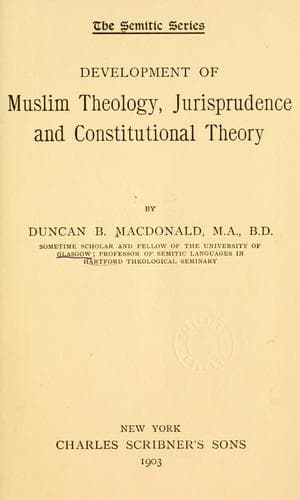
Development of Muslim Theology, Jurisprudence, and Constitutional TheoryMacDonald, Duncan Black
ReligionIslamic
Development of Muslim Theology, Jurisprudence, and Constitutional Theory
MacDonald, Duncan Black
Constitutional law (Islamic law); Islam -- Doctrines -- History; Islam and state -- History; Islamic law -- History
degree the defects we have already noticed in al-Farabi. To them must be
added the most simple skimming of all real philosophical problems and a
treatment of nature and natural science which had lost all connection
with facts.
[Sidenote: THE IKHWAN AND THE FATIMIDS]
It has been suggested, and the suggestion seems luminous and fertile,
that this Fraternity was simply a part of the great Fatimid propaganda
which, as we know, honey-combed the ground everywhere under the Sunnite
Abbasids. Descriptions which have reached us of the methods followed
by the leaders of the Fraternity agree exactly with those of the
missionaries of the Isma‘ilians. They raised difficulties and suggested
serious questionings; hinted at possible answers but did not give them;
referred to a source where all questions would be answered. Again,
their catch-words and fixed phrases are the same as those afterward
used by the Assassins, and we have traces of these Epistles forming a
part of the sacred library of the Assassins. It is to be remembered
that the Assassins were not simply robber bands who struck terror by
their methods. Both the western and the eastern branches were devoted
to science, and it may be that in their mountain fortresses there
was the most absolute devotion to true learning that then existed.
When the Mongols captured Alamut, they found it rich in MSS. and in
instruments and apparatus of every kind. It is then possible that the
elevated eclecticism of the _Ikhwan as-safa_ was the real doctrine of
the Fatimids, the Assassins, the Qarmatians and the Druses; certainly,
wherever we can test them there is the most singular agreement. It is a
mechanical and æsthetic pantheism, a glorification of Pythagoreanism,
with its music and numbers; idealistic to the last degree; a worship and
pursuit of a conception of a harmony and beauty in all the universe,
to find which is to find and know the Creator Himself. It is thus far
removed from materialism and atheism, but could easily be misrepresented
as both. This, it is true, is a very different explanation from the one
given in our first Part; it can only be put along-side of that and left
there. The one expresses the practical effect of the Isma‘ilians in
Islam; the other what may have been their ideal. However we judge them,
we must always remember that somewhere in their teaching, at its best,
there was a strange attraction for thinking and troubled men. Nasir ibn
Khusraw, a Persian Faust, found peace at Cairo between 437 and 444 in
recognizing the divine Imamship of al-Mustansir, and after a life of
persecution died in that faith as a hermit in the mountains of Badakhshan
in 481. The great Spanish poet, Ibn Hani, who died in 362, similarly
accepted al-Mu‘izz as his spiritual chief and guide.
[Sidenote: IBN KARRAM]
Public-domain text, read in full here on John Shaqi.
Reviews
Reviews
No reviews yet
Be the first to share your thoughts on this work.
Elsewhere in the archive
Join the Discussion
Join the discussion
Sign in to leave a comment or review.
Sign InorCreate an account