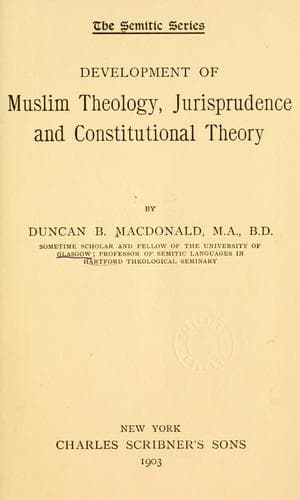
Development of Muslim Theology, Jurisprudence, and Constitutional TheoryMacDonald, Duncan Black
ReligionIslamic
Development of Muslim Theology, Jurisprudence, and Constitutional Theory
MacDonald, Duncan Black
Constitutional law (Islamic law); Islam -- Doctrines -- History; Islam and state -- History; Islamic law -- History
Another eclectic sect, but on a very different principle, was that of the
Karramites, founded by Abu Abd Allah ibn Karram, who died in 256. Its
teachings had the honor to be accepted and protected by no less a man
than the celebrated Mahmud of Ghazna (388-421), Mahmud the Idol-breaker,
the first invader of India and the patron of al-Beruni, Firdawsi, Ibn
Sina and many another. But that, to which we will return, belongs to a
later date and, probably, to a modified form of Ibn Karram’s teaching.
For himself, he was an ascetic of Sijistan and, according to the story,
a man of no education. He lost himself in theological subtleties which
he seems to have failed to understand. However, out of them all he put
together a book which he called “The Punishment of the Grave,” which
spread widely in Khurasan. It was, in part, a frank recoil to the
crassest anthropomorphism. Thus, for him, God actually sat upon the
throne, was in a place, had direction and so could move from one point
to another. He had a body with flesh, blood, and limbs; He could be
embraced by those who were purified to the requisite point. It was a
literal acceptance of the material expressions of the Qur’an along with a
consideration of how they could be so, and an explanation by comparison
with men—all opposed to the principle _bila kayfa_. So, apparently,
we must understand the curious fact that he was also a Murji’ite and
held faith to be only acknowledgment with the tongue. All men, except
professed apostates, are believers, he said, because of that primal
covenant, taken by God with the seed of Adam, when He asked, “Am I not
your Lord?” (_Alastu bi-rabbikum_) and they, brought forth from Adam’s
loins for the purpose, made answer, “Yea, verily, in this covenant
we remain until we formally cast it off.” This, of course, involved
taking God’s qualities in the most literal sense. So, if we are to see
in the Mu‘tazilites scholastic commentators trying to reduce Muhammad,
the poet, to logic and sense, we must see in Ibn Karram one of those
wooden-minded literalists, for whom a metaphor is a ridiculous lie if it
cannot be taken in its external meaning. He was part of the great stream
of conservative reaction, in which we find also such a man as Ahmad ibn
Hanbal. But the saving salt of Ahmad’s sense and reverence kept him by
the safe proviso “without considering how and without comparison.” All
Ahmad’s later followers were not so wise. In his doctrine of the state
Ibn Karram inclined to the Kharijites.
Before we return to al-Jubba‘i and the fate of the Mu‘tazilites, it
remains to trace more precisely the thread of mysticism, that _kashf_,
revelation, which we have already mentioned several times. Its
fundamental fact is that it had two sides, an ascetic and a speculative,
different in degree, in spirit and in result, and yet so closely
entangled that the same mystic has been assigned, in good and in bad
faith, as an adherent of both.
[Sidenote: WOMEN SAINTS]
Public-domain text, read in full here on John Shaqi.
Reviews
Reviews
No reviews yet
Be the first to share your thoughts on this work.
Elsewhere in the archive
Join the Discussion
Join the discussion
Sign in to leave a comment or review.
Sign InorCreate an account