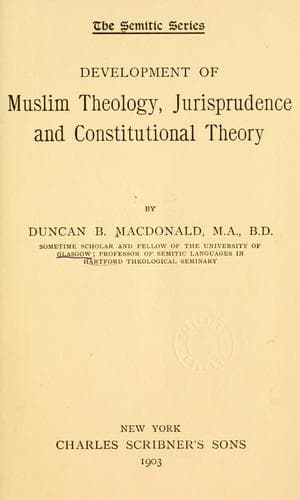
Development of Muslim Theology, Jurisprudence, and Constitutional TheoryMacDonald, Duncan Black
ReligionIslamic
Development of Muslim Theology, Jurisprudence, and Constitutional Theory
MacDonald, Duncan Black
Constitutional law (Islamic law); Islam -- Doctrines -- History; Islam and state -- History; Islamic law -- History
It is to the form of mysticism which sprang from asceticism that we must
first turn. Attention has been given above to the wandering monks and
hermits, the _sa’ihs_ (wanderers) and _rahibs_ who caught Muhammad’s
attention and respect. We have seen, too, how Muslim imitators began
in their turn to wander through the land, clad in the coarse woollen
robes which gave them the name of Sufis, and living upon the alms of the
pious. How early these appeared in any number and as a fixed profession
is uncertain, but we find stories in circulation of meetings between
such mendicant friars and al-Hasan al-Basri himself. Women, too, were
among them, and it is possible that to their influence a development of
devotional love-poetry was due. At least, many verses of this kind are
ascribed to a certain Rabi‘a, an ascetic and ecstatic devotee of the most
extreme other-worldliness, who died in 135. Many other women had part in
the contemplative life. Among them may be mentioned, to show its grasp
and spread, A’isha, daughter of Ja‘far as-Sadiq, who died in 145; Fatima
of Naysabur, who died in 223, and the Lady Nafisa, a contemporary and
rival in learning with ash-Shafi‘i and the marvel of her time in piety
and the ascetic life. Her grave is one of the most venerated spots in
Cairo, and at it wonders are still worked and prayer is always answered.
She was a descendant of al-Hasan, the martyred ex-Khalifa, and an example
of how the fated family of the Prophet was an early school for women
saints. Even in the Heathenism we have traces of female penitents and
hermits, and the tragedy of Ali and his sons and descendants gave scope
for the self-sacrifice, loving service and religious enthusiasm with
which women are dowered.
All these stood and stand in Islam on exactly the same footing as men.
The distinction in Roman Christendom that a woman cannot be a priest
there falls away, for in Islam is neither priest nor layman. They lived
either as solitaries or in conventual life exactly as did the men. They
were called by the same terms in feminine form; they were Sufiyas beside
the Sufis; Zahidas (ascetics) beside the Zahids; Waliyas (friends of
God) beside the Walis; Abidas (devotees) beside the Abids. They worked
wonders (_karamat_, closely akin to the χαρίσματα of 1 Cor. xii, 9)
by the divine grace, and still, as we have seen, at their own graves
such are granted through them to the faithful, and their intercession
(_shafa‘a_) is invoked. Their religious exercises were the same; they
held _dhikrs_ and women darwishes yet dance to singing and music in order
to bring on fits of ecstasy. To state the case generally, whatever is
said hereafter of mysticism and its workings among men must be taken as
applying to women also.
Public-domain text, read in full here on John Shaqi.
Reviews
Reviews
No reviews yet
Be the first to share your thoughts on this work.
Elsewhere in the archive
Join the Discussion
Join the discussion
Sign in to leave a comment or review.
Sign InorCreate an account