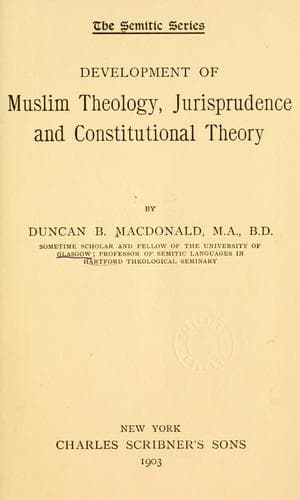
Development of Muslim Theology, Jurisprudence, and Constitutional TheoryMacDonald, Duncan Black
ReligionIslamic
Development of Muslim Theology, Jurisprudence, and Constitutional Theory
MacDonald, Duncan Black
Constitutional law (Islamic law); Islam -- Doctrines -- History; Islam and state -- History; Islamic law -- History
To return: one of the earliest male devotees of whom we have distinct
note is Ibrahim ibn Adham. He was a wanderer of royal blood, drifted
from Balkh in Afghanistan to al-Basra and to Mecca. He died in 161.
Contempt for the learning of lawyers and for external forms appears in
him; obedience to God, contemplation of death, death to the world formed
his teaching. Another, Da’ud ibn Nusayr, who died in 165, was wont to
say, “Flee men as thou fleest a lion. Fast from the world and let the
breaking of thy fast be when thou diest.” Another, al-Fudayl ibn Iyad of
Khurasan, who died in 187, was a robber converted by a heavenly voice;
he cast aside the world, and his utterances show that he lapsed into the
passivity of quietism.
Reference has already been made in the chapter on jurisprudence to
the development of asceticism which came with the accession of the
Abbasids. The disappointed hopes of the old believers found an outlet
in the contemplative life. They withdrew from the world and would have
nothing to do with its rulers; their wealth and everything connected
with them they regarded as unclean. Ahmad ibn Hanbal in his later life
had to use all his obstinacy and ingenuity to keep free of the court and
its contamination. Another was this al-Fudayl. Stories—chronologically
impossible—are told how he rebuked Harun ar-Rashid for his luxury and
tyranny and denounced to his face his manner of life. With such an
attitude to those round him he could have had little joy in his devotion.
So it was said, “When al-Fudayl died, sadness was removed from the world.”
[Sidenote: PASSAGE OF ASCETICISM TO ECSTASY]
Public-domain text, read in full here on John Shaqi.
Reviews
Reviews
No reviews yet
Be the first to share your thoughts on this work.
Elsewhere in the archive
Join the Discussion
Join the discussion
Sign in to leave a comment or review.
Sign InorCreate an account