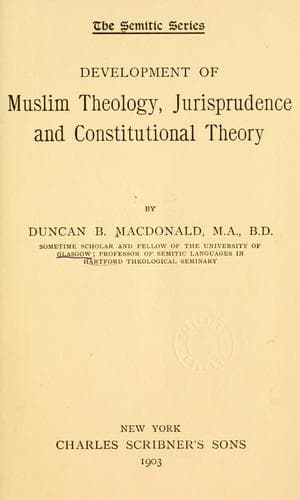
Development of Muslim Theology, Jurisprudence, and Constitutional TheoryMacDonald, Duncan Black
ReligionIslamic
Development of Muslim Theology, Jurisprudence, and Constitutional Theory
MacDonald, Duncan Black
Constitutional law (Islamic law); Islam -- Doctrines -- History; Islam and state -- History; Islamic law -- History
But the roots of Sufiism struck also in another direction. We have
already seen an early tendency to regard Ali and, later, members of his
house as incarnations of divinity. In the East, where God comes near to
man, the conception of God in man is not difficult. The Semitic prophet
through whom God speaks easily slips over into a divine being in whom
God exists and may be worshipped. But if with one, why not with another?
May it not be possible by purifying exercises to reach this unity? If
one is a Son of God, may not all become that if they but take the means?
The half-understood pantheism which always lurks behind oriental fervors
claims its due. From his wild whirling dance, the darwish, stung to
cataleptic ecstasy by the throbbing of the drums and the lilting chant,
sinks back into the unconsciousness of the divine oneness. He has passed
temporarily from this scene of multiplicity into the sea of God’s unity
and, at death, if he but persevere, he will reach that haven where he
fain would be and will abide there forever. Here, we have not to do with
calm philosophers rearing their systems in labored speculations, but with
men, often untaught, seeking the salvation of their souls earnestly and
with tears.
[Sidenote: PANTHEISTIC SCHOOL]
One of the earliest of the pantheistic school was Abu Yazid al-Bistami
(d. 261). He was of Persian parentage, and his father had been a follower
of Zarathustra. As an ascetic he was of the highest repute; he was also
an author of eminence on Sufiism (al-Ghazzali used his books) and he
joined to his devout learning and self-mortification clear miraculous
gifts. But equally clear was his pantheistic drift and his name has
come down linked to the saying, “Beneath my cloak there is naught else
than God.” It is worth noticing that certain other of his sayings show
that, even in his time, there were Sufi saints who boasted that they had
reached such perfection and such miraculous powers that the ordinary
moral and ceremonial law no longer applied to them. The antinomianism
which haunted the later Sufiism and darwishdom had already appeared.
[Sidenote: AL-HALLAJ]
Public-domain text, read in full here on John Shaqi.
Reviews
Reviews
No reviews yet
Be the first to share your thoughts on this work.
Elsewhere in the archive
Join the Discussion
Join the discussion
Sign in to leave a comment or review.
Sign InorCreate an account