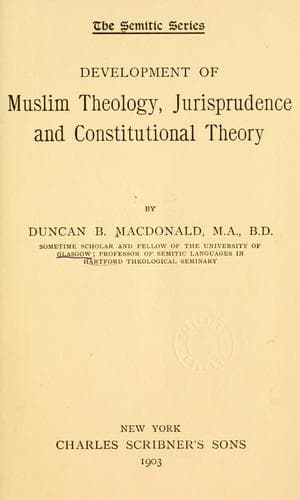
Development of Muslim Theology, Jurisprudence, and Constitutional TheoryMacDonald, Duncan Black
ReligionIslamic
Development of Muslim Theology, Jurisprudence, and Constitutional Theory
MacDonald, Duncan Black
Constitutional law (Islamic law); Islam -- Doctrines -- History; Islam and state -- History; Islamic law -- History
On the other vexed question of free-will, or, rather, as the Muslims
chose to express it, on the ability of men to produce actions, he took
up a mediating position. The old orthodox position was absolutely
fatalistic; the Mu‘tazilites, following their principle of Justice, gave
to man an initiative power. Al-Ash‘ari struck a middle path. Man cannot
create anything; God is the only creator. Nor does man’s power produce
any effect on his actions at all. God creates in His creature power
(_qudra_) and choice (_ikhtiyar_). Then He creates in him his action
corresponding to the power and choice thus created. So the action of the
creature is created by God as to initiative and as to production; but
it is _acquired_ by the creature. By acquisition (_kasb_) is meant that
it corresponds to the creature’s power and choice, previously created
in him, without his having had the slightest effect on the action. He
was only the _locus_ or subject of the action. In this way al-Ash‘ari
is supposed to have accounted for free-will and entailed responsibility
upon men. It may be doubted whether the second point occupied him much.
It was open to his God to do good or evil as He chose; the Justice of the
Mu‘tazilites was left behind. He may have intended only to explain the
consciousness of freedom, as some have done more recently. The closeness
with which al-Ash‘ari in this comes to the pre-established harmony of
Leibnitz and to the Kantian conception of existence shows how high a rank
he must take as an original thinker. His abandoning of the Mu‘tazilites
was due to no mere wave of sentiment but to a perception that their
speculations were on too narrow a basis and of a too barren scholastic
type. He died after 320 with a curse on them and their methods as his
last words.
[Sidenote: AL-MATARIDI]
A few words only need be given to al-Mataridi. The creed of an-Nasafi
in the Appendix of Creeds, pp. 308-315 belongs to his school. He and
at-Tahawi were followers of the broad-minded Abu Hanifa, who was more
than suspected of Mu‘tazilite and Murji’ite leanings. Muslim theologians
usually reckon up some thirteen points of difference between al-Mataridi
and al-Ash‘ari and admit that seven of these are not much more than
combats of words. Those which occur in an-Nasafi’s creed are marked with
a star.
Public-domain text, read in full here on John Shaqi.
Reviews
Reviews
No reviews yet
Be the first to share your thoughts on this work.
Elsewhere in the archive
Join the Discussion
Join the discussion
Sign in to leave a comment or review.
Sign InorCreate an account