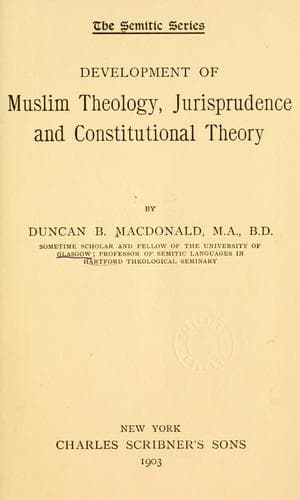
Development of Muslim Theology, Jurisprudence, and Constitutional TheoryMacDonald, Duncan Black
ReligionIslamic
Development of Muslim Theology, Jurisprudence, and Constitutional Theory
MacDonald, Duncan Black
Constitutional law (Islamic law); Islam -- Doctrines -- History; Islam and state -- History; Islamic law -- History
We are now in a position to finish shortly with the Mu‘tazilites. Their
work, as a constructive force, is done. From this time on there is
_kalam_ among the orthodox, and the term _mutakallim_ denotes nothing but
a scholastic theologian, whether of one wing or another. And so, like
any other organ which has done its part and for the existence of which
there is no longer any object, they gradually and quietly dropped into
the background. They had still, sometimes, to suffer persecution, and
for hundreds of years there were men who continued to call themselves
Mu‘tazilites; but their heresies came to be heresies of the schools
and not burning questions in the eyes of the masses. We need now draw
attention to only a few incidents and figures in this dying movement.
The Muslim historians lay much stress on the orthodox zeal of the
Khalifa al-Qadir, who reigned 381-422, and narrate how he persecuted the
Mu‘tazilites, Shi‘ites and other heretics and compelled them, under oath,
to conform.
But there are several difficulties in the way of this persecution, which
make it probable that it was more nominal than otherwise. Al-Qadir was
bitterly orthodox; he had written a treatise on theology and compelled
his unhappy courtiers to listen to a public reading of it every week.
But he enjoyed, outside of his palace, next to no power. He was in the
control of the Shi‘ite Buwayhids, who, as we have seen, ruled Baghdad and
the Khalifate from 320 to 447. These dubious persecutions are said to
have fallen in 408 and 420. Again, a Muslim pilgrim from Spain visited
Baghdad about 390 and has left us a record of the state of religious
things there. He found in session what may perhaps best be described as
a Parliament of Religions. It seems to have been a free debate between
Muslims of all sects, orthodox and heretical, Parsees and atheists, Jews
and Christians—unbelievers of every kind. Each party had a spokesman,
and at the beginning of the proceedings the rule was rehearsed that
no one might appeal to the sacred books of his creed but might only
adduce arguments founded upon reason. The pious Spanish Muslim went to
two meetings but did not peril his soul by any further visits. In his
narrative we recognize the horror with which the orthodox of Spain viewed
such proceedings—Spain, Muslim and Christian, has always favored the
straitest sect; but when such a thing was permitted in Baghdad, religious
liberty there at least must have been tolerably broad. Possibly it was
sittings of the _Ikhwan as-safa_ upon which this scandalized Spaniard
stumbled. He himself speaks of them as meetings of mutakallims.
[Sidenote: MAHMUD OF GHAZNA]
Public-domain text, read in full here on John Shaqi.
Reviews
Reviews
No reviews yet
Be the first to share your thoughts on this work.
Elsewhere in the archive
Join the Discussion
Join the discussion
Sign in to leave a comment or review.
Sign InorCreate an account