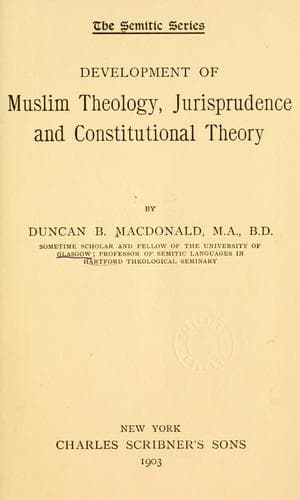
Development of Muslim Theology, Jurisprudence, and Constitutional TheoryMacDonald, Duncan Black
ReligionIslamic
Development of Muslim Theology, Jurisprudence, and Constitutional Theory
MacDonald, Duncan Black
Constitutional law (Islamic law); Islam -- Doctrines -- History; Islam and state -- History; Islamic law -- History
But if the mixture of Sunnite and Shi‘ite authority in Baghdad gave
all the miscellaneous heretics a chance for life, it was different in
the growing dominions of Mahmud of Ghazna. That iconoclastic monarch
had embraced the anthropomorphic faith of the Karramites, the most
literal-minded of all the Muslim sects. In consequence, all forms of
Mu‘tazilism and all kinds of mutakallims were an abomination to him,
and it was a very real persecution which they met at his hands. That
al-Qadir, his spiritual suzerain, urged him on is very probable; it is
also possible that respect for the growing power of Mahmud may have
protected al-Qadir to some extent from the Buwayhids. In 420 Mahmud took
from them Ispahan and held there a grand inquisition on Shi‘ites and
heretics of all kinds.
To proceed with the Mu‘tazilites; when we come to al-Ghazzali and his
times we shall find that they have ceased to be a crying danger to the
faith. Though their views might, that doctor held, be erroneous in some
respects, they were not to be considered as damnable. Again, in 538,
there died az-Zamakhshari, the great grammarian, who is often called
the last of the Mu‘tazilites. He was not that by any means, but his
heresies were either mild or were regarded mildly. A single point will
show this. His commentary on the Qur’an, the _Kashshaf_, was revised
and expurgated in the orthodox interest by al-Baydawi (d. 688) and in
that form is now the most popular and respected of all expositions. The
_Kashshaf_ itself, in its original, unmodified form, has been printed
several times at Cairo. Again, Ibn Rushd, the Aristotelian, who died in
595, when he is combating the arguments of the mutakallims, makes little
difference between the Mu‘tazilites and the others. They are only, to
him, another variety of scholastic theologian, with a rather better idea,
perhaps, of logic and argument. He considered, as we shall find later,
all the mutakallims as sadly to seek in such matters. Since then, and
into quite modern times, there have been sporadic cases of theologians
called Mu‘tazilites by themselves or others. Practically, they have
been scholastics of eccentric views. Finally, the use of this name for
themselves by the present-day broad school Muslims of India is absolutely
unhistorical and highly misleading.
We turn now to suggest, rather than to trace, some of the non-theological
consequences of the preceding theology.
[Sidenote: AL-BERUNI; IBN SINA]
Public-domain text, read in full here on John Shaqi.
Reviews
Reviews
No reviews yet
Be the first to share your thoughts on this work.
Elsewhere in the archive
Join the Discussion
Join the discussion
Sign in to leave a comment or review.
Sign InorCreate an account