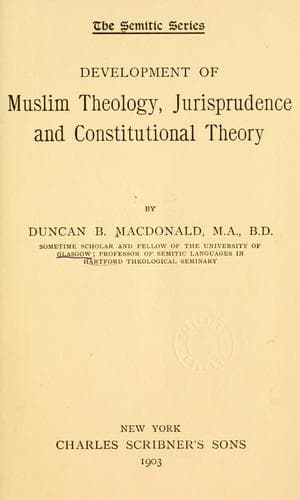
Development of Muslim Theology, Jurisprudence, and Constitutional TheoryMacDonald, Duncan Black
ReligionIslamic
Development of Muslim Theology, Jurisprudence, and Constitutional Theory
MacDonald, Duncan Black
Constitutional law (Islamic law); Islam -- Doctrines -- History; Islam and state -- History; Islamic law -- History
Increasingly, from this time on, it is not heresy which has to be met
so much as simple unbelief, more or less frank. It is evident that the
heretics of the earlier period are now dividing in two directions,
one part inclining toward milder forms of heresy and the other toward
doubt in the largest sense, passing over to Aristotelian + neo-Platonic
philosophy, and thence dividing into materialists, deists, and theists.
Thus we have seen earlier the workings of al-Farabi and of the Ikhwan
as-safa. The teachings of the latter pass on to the Isma‘ilians who
developed them in the mountain fortresses, the centres of their power,
scattered from Persia to Syria. These were otherwise called Assassins;
otherwise Batinites in the narrower sense—in the broader that term
meant only those who found under the letter of the Qur’an a hidden,
esoteric meaning; otherwise Ta‘limites or claimers of a _ta‘lim_, a
secret teaching by a divinely instructed Imam, and with them we shall
have much to do later. It is sufficient here to notice how the peaceful
and rather watery philosophy of the “Sincere Brethren” was transmuted
through ambition and fanaticism into belligerent politics at the hands
and daggers of these fierce sectaries. Into this period, too, fall some
well-known names of dubious and more than dubious orthodoxy. Al-Beruni
(d. 440) even at the court of Mahmud of Ghazna managed to keep his
footing and his head. Yet it may be doubted how far he was a Karramite
or even a Muslim. He was certainly the first scientific student of India
and _Indica_ and of chronology and calendars, a man whose attainments
and results show that our so-called modern methods are as old as genius.
On religion, he maintained a prudent silence, but earned the favor of
Mahmud by an unsparing exposure of the weakness in the Fatimid genealogy.
In this sketch he has a place as a man of science who went his own way
without treading on the religious toes of other people.
Public-domain text, read in full here on John Shaqi.
Reviews
Reviews
No reviews yet
Be the first to share your thoughts on this work.
Elsewhere in the archive
Join the Discussion
Join the discussion
Sign in to leave a comment or review.
Sign InorCreate an account