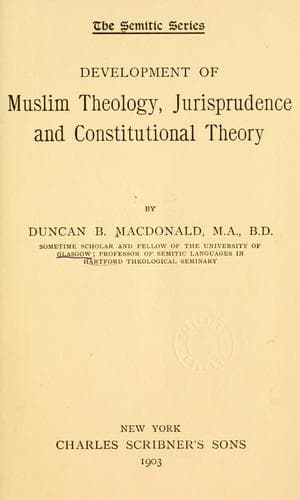
Development of Muslim Theology, Jurisprudence, and Constitutional TheoryMacDonald, Duncan Black
ReligionIslamic
Development of Muslim Theology, Jurisprudence, and Constitutional Theory
MacDonald, Duncan Black
Constitutional law (Islamic law); Islam -- Doctrines -- History; Islam and state -- History; Islamic law -- History
His contemporary Ibn Sina (d. 428), for us Avicenna, was of a different
nature, and his lines were cast in different places. He was a wanderer
through the courts of northern Persia. The orthodox and stringent Mahmud
he carefully avoided; the Buwayhids and those of their ilk took such
heresies as his more easily. Endowed with a gigantic memory and an
insatiable intellectual appetite, he was the encyclopædist of his age,
and his scientific work, and especially that in medicine, went further
than anything else to put the Muslim East and mediæval Europe in the
strait waistcoat from which the first has not yet emerged and the second
only shook itself free in the seventeenth century. He was a student
of Aristotle and a mystic, as all Muslim students of Aristotle have
been. How far his mysticism enabled him to square the Qur’an with his
philosophy is not clear; such men seldom said exactly what they meant
and all that they thought. He was also a diligent student and reader of
the Qur’an and faithful in his public religious duties. Yet the Muslim
world asserts that he left behind him a testamentary tractate (_wasiya_)
defending dissimulation as to the religion of the country in which
we might be; that it was not wrong for the philosopher to go through
religious rites which for him had no meaning. He, too, is significant for
his time, and, if our interest were philosophy, would call for lengthened
treatment. As it is, he marks for us the accomplished separation between
students of theology and students of philosophy.
An equally well known and by us much better loved name is that of Umar
al-Khayyam, who died later, about 515, but who may fitly be grouped with
Ibn Sina. He, too, was a _bon vivant_, but of a deeper, more melancholy
strain. His wine meant more than friendly cups; it was a way of escape
from the world and its burden. His science, too, went deeper. He was not
a gatherer and arranger of the wisdom of the past; his reformed calendar
is more perfect than that which we even now use. His faith is a riddle to
us, as it was to his comrades. But it was because he had no certain truth
to proclaim that Umar did not speak out clearly. His last words were
almost those of Rabelais, “I go to meet the great Perhaps.” Anecdotage
connects his name with that of al-Ghazzali. Neither had escaped the pall
of universal scepticism which must have descended upon their time. But
al-Ghazzali, by God’s grace, as he himself reverently says, was enabled
to escape. Umar died under it.
[Sidenote: ABU-L-ALA AL-MA‘ARRI]
Public-domain text, read in full here on John Shaqi.
Reviews
Reviews
No reviews yet
Be the first to share your thoughts on this work.
Elsewhere in the archive
Join the Discussion
Join the discussion
Sign in to leave a comment or review.
Sign InorCreate an account