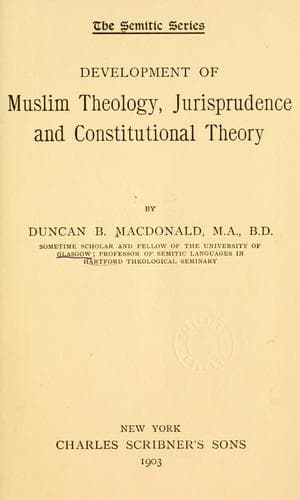
Development of Muslim Theology, Jurisprudence, and Constitutional TheoryMacDonald, Duncan Black
ReligionIslamic
Development of Muslim Theology, Jurisprudence, and Constitutional Theory
MacDonald, Duncan Black
Constitutional law (Islamic law); Islam -- Doctrines -- History; Islam and state -- History; Islamic law -- History
A very different man was Abu-l-Ala al-Ma‘arri, the blind poet and singer
of intellectual freedom. In Arabic literature there is no other voice
like his, clear and confident. He was a man of letters; no philosopher
nor theologian nor scientist, though at one time he seems to have come
in contact with a circle like that of Ikhwan as-safa, perhaps the same;
and his spirit was like that of one of the heroic poets of the old desert
life, whose hand was taught to keep his head, whose tongue spared nothing
from heaven to earth, and who lived his own life out in his own way,
undaunted. In his darkness he nourished great thoughts and flung out a
_sæva indignatio_ on hypocrisy and subservience which reminds of Lessing.
But Abu-l-Ala was a great poet, and his scorn of priests and courtiers
and their lies, his pity for suffering humanity and his confidence in
the light of reason are thrown into scraps of burning, echoing verse
without their like in Arabic. He died at the town of his birth, Ma‘arrat
an-Nu‘man, in northern Syria, in 449. The problem is how he was suffered
to live out his long life of eighty-six years.
We can now return to the development of scholastic theology in the
orthodox church at the hands of the followers of al-Ash‘ari. They
had to fight their way against many and most differing opponents. At
the one extreme were the dwindling Mu‘tazilites, passing slowly into
comparatively innocuous heretics, and the growing party of unbelievers,
philosophical and otherwise, open and secret. At the other extreme was
the mob of Hanbalites, belonging to the only legal school which laid
theological burdens on its adherents. The theologians, in this case,
certainly varied as to the weight of their own anathemas against all
kalam, but were at one in that they carried the bulk of the multitude
with them and could enforce their conclusions with the cudgels of
rioters. In the midst were the rival orthodox (_pace_ the Hanbalites)
developers of kalam, among whom the Mataridites probably held the most
important place. Thus, the Ash‘arite school was the nursling as well as
the child of controversy.
Public-domain text, read in full here on John Shaqi.
Reviews
Reviews
No reviews yet
Be the first to share your thoughts on this work.
Elsewhere in the archive
Join the Discussion
Join the discussion
Sign in to leave a comment or review.
Sign InorCreate an account