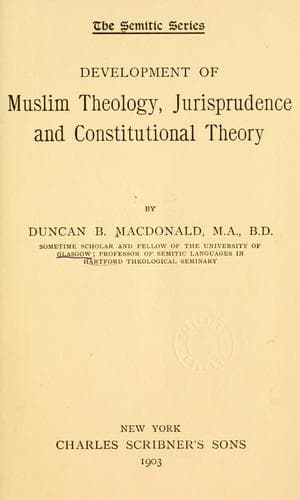
Development of Muslim Theology, Jurisprudence, and Constitutional TheoryMacDonald, Duncan Black
ReligionIslamic
Development of Muslim Theology, Jurisprudence, and Constitutional Theory
MacDonald, Duncan Black
Constitutional law (Islamic law); Islam -- Doctrines -- History; Islam and state -- History; Islamic law -- History
It was, then, fitting that the name joined, at least in tradition, with
the final form of that system, should be that of a controversialist.
But this man, Abu Bakr al-Baqilani the Qadi, was more than a mere
controversialist. It is his glory to have contributed most important
elements to and put into fixed form what is, perhaps, the most fantastic
and daring metaphysical scheme, and almost certainly the most thorough
theological scheme, ever thought out. On the one hand, the Lucretian
atoms raining down through the empty void, the self-developing monads
of Leibnitz, pre-established harmony and all, the Kantian “things in
themselves” are lame and impotent in their consistency beside the
parallel Ash‘arite doctrines; and, on the other, not even the rigors
of Calvin, as developed in the Dutch confessions, can compete with the
unflinching exactitude of the Muslim conclusions.
[Sidenote: ASH‘ARITE METAPHYSICS]
First, as to ontology. The object of the Ash‘arites was that of Kant, to
fix the relation of knowledge to the thing in itself. Thus, al-Baqilani
defined knowledge (_ilm_) as cognition (_ma‘rifa_) of a thing as it is
in itself. But in reaching that “thing in itself” they were much more
thorough than Kant. Only two of the Aristotelian categories survived
their attack, substance and quality. The others, quantity, place, time
and the rest, were only relationships (_i‘tibars_) existing subjectively
in the mind of the knower, and not things. But a relationship, they
argued, if real, must exist in something, and a quality cannot exist in
another quality, only in a substance. Yet it could not exist in either
of the two things which it brought together; for example, in the cause
or the effect. It must be in a third thing. But to bring this third
thing and the first two together, other relationships would be needed
and other things for these relationships to exist in. Thus we would be
led back in an infinite sequence, and they had taken over from Aristotle
the position that such an infinite series backward (_tasalsul_) is
inadmissible. Relationships, then, had no real existence but were mere
phantoms, subjective non-entities. Further, the Aristotelian view of
matter was now impossible for them. All the categories had gone except
substance and quality; and among them, passion. Matter, then, could not
have the possibility of suffering the impress of form. A possibility
is neither an entity nor a non-entity, but a subjectivity purely. But
with the suffering matter, the active form and all causes must also go.
They, too, are mere subjectivities. Again, qualities, for these thinkers,
became mere accidents. The fleeting character of appearances drove them
to the conclusion that there was no such thing as a quality planted
in the nature of a thing; that the idea “nature” did not exist. Then
this drove them further. Substances exist only with qualities, _i.e._,
accidents. These qualities may be positive or they may be negative;
Public-domain text, read in full here on John Shaqi.
Reviews
Reviews
No reviews yet
Be the first to share your thoughts on this work.
Elsewhere in the archive
Join the Discussion
Join the discussion
Sign in to leave a comment or review.
Sign InorCreate an account