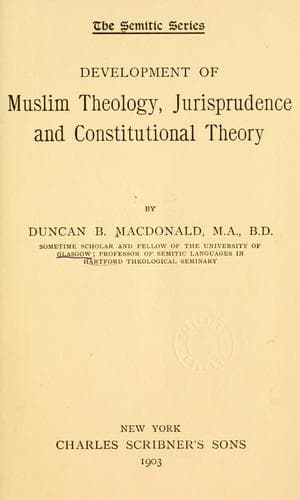
Development of Muslim Theology, Jurisprudence, and Constitutional TheoryMacDonald, Duncan Black
ReligionIslamic
Development of Muslim Theology, Jurisprudence, and Constitutional Theory
MacDonald, Duncan Black
Constitutional law (Islamic law); Islam -- Doctrines -- History; Islam and state -- History; Islamic law -- History
the ascription to things of negative qualities is one of their most
fruitful conceptions. When, then, the qualities fall out of existence,
the substances themselves must also cease to exist. Substance as well as
quality is fleeting, has only a moment’s duration.
But when they rejected the Aristotelian view of matter as the possibility
of receiving form, their path of necessity led them straight to the
atomists. So atomists they became, and, as always, after their own
fashion. Their atoms are not of space only, but also of time. The basis
of all the manifestation, mental and physical, of the world in place
and time, is a multitude of monads. Each has certain qualities but has
extension neither in space nor time. They have simply position, not bulk,
and do not touch one another. Between them is absolute void. Similarly as
to time. The time-atoms, if the expression may be permitted, are equally
unextended and have also absolute void—of time—between them. Just as
space is only in a series of atoms, so time is only in a succession of
untouching moments and leaps across the void from one to the other with
the jerk of the hand of a clock. Time, in this view, is in grains and can
exist only in connection with change. The monads differ from those of
Leibnitz in having no nature in themselves, no possibility of development
along certain lines. The Muslim monads are, and again are not, all change
and action in the world are produced by their entering into existence and
dropping out again, not by any change in themselves.
But this most simple view of the world left its holders in precisely the
same difficulty, only in a far higher degree, as that of Leibnitz. He was
compelled to fall back on a pre-established harmony to bring his monads
into orderly relations with one another; the Muslim theologians, on their
side, fell back upon God and found in His will the ground of all things.
[Sidenote: ASH‘ARITE THEOLOGY]
We here pass from their ontology to their theology, and as they
were thorough-going metaphysicians, so now they are thorough-going
theologians. Being was all in the one case; now it is God that is all.
In truth, their philosophy is in its essence a scepticism which destroys
the possibility of a philosophy in order to drive men back to God and
His revelations and compel them to see in Him the one grand fact of the
universe. So, when a darwish shouts in his ecstasy, “_Huwa-l-haqq_,” he
does not mean, “He is the Truth,” in our Western sense of Verity, or our
New Testament sense of “The Way, the Truth, and the Life,” but simply,
“He is the Fact”—the one Reality.
Public-domain text, read in full here on John Shaqi.
Reviews
Reviews
No reviews yet
Be the first to share your thoughts on this work.
Elsewhere in the archive
Join the Discussion
Join the discussion
Sign in to leave a comment or review.
Sign InorCreate an account