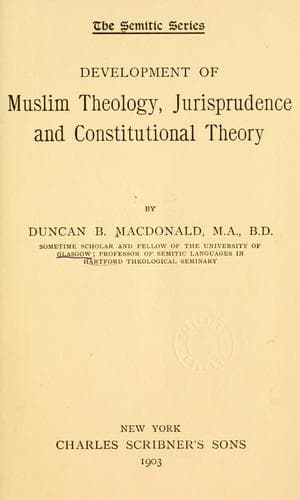
Development of Muslim Theology, Jurisprudence, and Constitutional TheoryMacDonald, Duncan Black
ReligionIslamic
Development of Muslim Theology, Jurisprudence, and Constitutional Theory
MacDonald, Duncan Black
Constitutional law (Islamic law); Islam -- Doctrines -- History; Islam and state -- History; Islamic law -- History
To return: from their ontology they derived an argument for the
necessity of a God. That their monads came so and not otherwise must have
a cause; without it there could be no harmony or connection between them.
And this cause must be one with no cause behind it; otherwise we would
have the endless chain. This cause, then, they found in the absolutely
free will of God, working without any matter beside it and unaffected by
any laws or necessities. It creates and annihilates the atoms and their
qualities and, by that means, brings to pass all the motion and change of
the world. These, in our sense, do not exist. When a thing seems to us to
be moved, that really means that God has annihilated—or permitted to drop
out of existence, by not continuing to uphold, as another view held—the
atoms making up that thing in its original position, and has created them
again and again along the line over which it moves. Similarly of what
we regard as cause and effect. A man writes with a pen and a piece of
paper. God creates in his mind the will to write; at the same moment he
gives him the power to write and brings about the apparent motion of the
hand, of the pen and the appearance on the paper. No one of these is the
cause of the other. God has brought about by creation and annihilation
of atoms the requisite combination to produce these appearances. Thus we
see that free-will for the Muslim scholastics is simply the presence, in
the mind of the man, of this choice created there by God. This may not
seem to us to be very real, but it has, certainly, as much reality as
anything else in their world. Further, it will be observed how completely
this annihilates the machinery of the universe. There is no such thing
as law, and the world is sustained by a constant, ever-repeated miracle.
Miracles and what we regard as the ordinary operations of nature are on
the same level. The world and the things in it could have been quite
different. The only limitation upon God is that He cannot produce a
contradiction. A thing cannot be and not be at the same time. There is
no such thing as a secondary cause; when there is the appearance of
such, it is only illusional. God is producing it as well as the ultimate
appearance of effect. There is no nature belonging to things. Fire does
not burn and a knife does not cut. God creates in a substance a being
burned when the fire touches it and a being cut when the knife approaches
it.
[Sidenote: ETHICAL CONSEQUENCES]
Public-domain text, read in full here on John Shaqi.
Reviews
Reviews
No reviews yet
Be the first to share your thoughts on this work.
Elsewhere in the archive
Join the Discussion
Join the discussion
Sign in to leave a comment or review.
Sign InorCreate an account