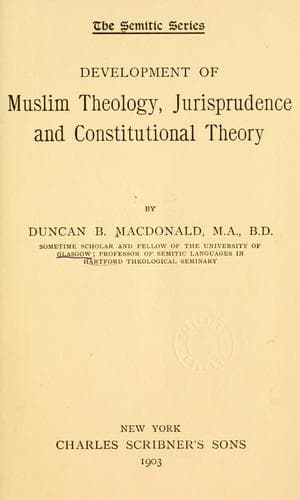
Development of Muslim Theology, Jurisprudence, and Constitutional TheoryMacDonald, Duncan Black
ReligionIslamic
Development of Muslim Theology, Jurisprudence, and Constitutional Theory
MacDonald, Duncan Black
Constitutional law (Islamic law); Islam -- Doctrines -- History; Islam and state -- History; Islamic law -- History
In this scheme there are certainly grave difficulties, philosophical
and ethical. It establishes a relationship between God and the atoms;
but we have already seen that relationships are subjective illusions.
That, however, was in the case of the things of the world, perceived
by the senses—contingent being, as they would put it. It does not hold
of necessary being. God possesses a quality called Difference from
originated things (_al-mukhalafa lil-hawadith_). He is not a natural
cause, but a free cause; and the existence of a free cause they were
compelled by their principles to admit. The ethical difficulty is perhaps
greater. If there is no order of nature and no certainty, or nexus,
as to causes and effects; if there is no regular development in the
life, mental, moral, and physical of a man—only a series of isolated
moments; how can there be any responsibility, any moral claim or duty?
This difficulty seems to have been recognized more clearly than the
philosophical one. It was met formally by the assertion of a certain
order and regularity in the will of God. He sees to it that a man’s
life is a unity, and, for details, that the will to eat and the action
always coincide. But such an answer must have been felt to be inadequate
and to involve grave moral dangers for the common mind. Therefore, as
we have seen, the study of kalam was hedged about with difficulties and
restrictions. Theologians recognized its trap-falls and doubts, even for
themselves, and lamented that they were compelled by their profession
to study it. The public discussion of its questions was regarded as a
breach of professional etiquette. Theologians and philosophers alike
strove to keep these deeper mysteries hidden from the multitude. The gap
between the highly educated and the great mass—that fundamental error and
greatest danger in Muslim society—comes here again to view. Further, even
among theologians, there was some difference in degree of insight, and
books and phrases could be read by different men in very different ways.
To one, they would suggest ordinary, Qur’anic doctrines; another would
see under and behind them a trail of metaphysical consequences bristling
with blasphemous possibilities. Thus, Muslim science has been always of
the school; it has never learned the vitalizing and disinfecting value
of the fresh air of the market-place. This applies to philosophers even
more than to theologians. The crowning accusation which Ibn Rushd, the
great Aristotelian commentator, brought against al-Ghazzali was that he
discussed such subtilties in popular books.
[Sidenote: SPREAD OF ASH‘ARISM]
Public-domain text, read in full here on John Shaqi.
Reviews
Reviews
No reviews yet
Be the first to share your thoughts on this work.
Elsewhere in the archive
Join the Discussion
Join the discussion
Sign in to leave a comment or review.
Sign InorCreate an account