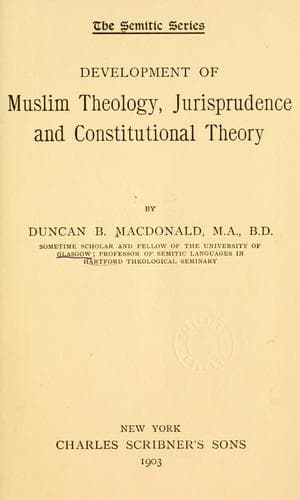
Development of Muslim Theology, Jurisprudence, and Constitutional TheoryMacDonald, Duncan Black
ReligionIslamic
Development of Muslim Theology, Jurisprudence, and Constitutional Theory
MacDonald, Duncan Black
Constitutional law (Islamic law); Islam -- Doctrines -- History; Islam and state -- History; Islamic law -- History
This, then, was the system which seems to have reached tolerably
complete form at the hands of al-Baqilani, who died in 403. But with the
completion of the system there went by no means its universal or even
wide-spread acceptance in the Muslim world. That of al-Mataridi held its
own for long, and, even yet, the Mataridite creed of an-Nasafi is used
largely in the Turkish schools. In the fifth century it was considered
remarkable that Abu Dharr (d. 434), a theologian of Herat, should be
an Ash‘arite rather than, apparently, a Mataridite. It was not till
al-Ghazzali (d. 505) that the Ash‘arite system came to the orthodox
hegemony in the East, and it was only as the result of the work of Ibn
Tumart, the Mahdi of the Muwahhids (d. 524), that it conquered the West.
For long its path was darkened by suspicion and persecution. This came
almost entirely from the Hanbalites. The Mu‘tazilites had no force behind
them, and while the views of deists and materialists were steadily making
way in secret, their public efforts appeared only in very occasional
disputes between theologians and philosophers. As we have seen, Muslim
philosophy has always practised an economy of teaching.
The Hanbalite crisis seems to have come to a head toward the close of the
reign of Tughril Beg, the first Great Saljuq. In 429, as we have seen,
the Saljuqs had taken Merv and Samarqand, and in 447 Tughril Beg had
entered Baghdad and freed the Khalifa from the Shi‘ite domination of the
Buwayhids who had so long enforced toleration. It was natural that he, a
theologically unschooled Turk, should be captured by the simplicity and
concreteness of the Hanbalite doctrines.
Added to this political factor there was a theological movement at work
which was deeply hostile to the Ash‘arites as they had developed. An
important point in the method of al-Ash‘ari himself, and, after him, of
his followers, was to put forth a creed, expressed in the old-fashioned
terms and containing the old-fashioned doctrines as nearly as was at
all possible, and to accompany it with a spiritualizing interpretation
which was, naturally, accessible to the professional student only.
Accordingly what had at first seemed a weapon against the Mu‘tazilites
came to be viewed with more and more suspicion by the holders to the old,
unquestioning orthodoxy. The duty also of religious investigation and
speculation (_nazr_) came to have more and more stress laid upon it. The
_bila kayfa_ dropped into the background. A Muslim must have a reason for
the faith that was in him, they said; otherwise, he was no true Muslim,
was in fact an unbeliever. Of course, they limited carefully the extent
to which he should go. For the ordinary man a series of very simple
proofs would be prepared; the student, on the other hand, when carefully
led, could work his way through the system sketched above. All this,
naturally, was anathema to the party of tradition.
[Sidenote: IBN HAZM]
Public-domain text, read in full here on John Shaqi.
Reviews
Reviews
No reviews yet
Be the first to share your thoughts on this work.
Elsewhere in the archive
Join the Discussion
Join the discussion
Sign in to leave a comment or review.
Sign InorCreate an account