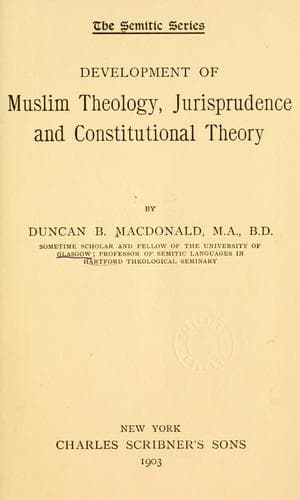
Development of Muslim Theology, Jurisprudence, and Constitutional TheoryMacDonald, Duncan Black
ReligionIslamic
Development of Muslim Theology, Jurisprudence, and Constitutional Theory
MacDonald, Duncan Black
Constitutional law (Islamic law); Islam -- Doctrines -- History; Islam and state -- History; Islamic law -- History
It is significant that at this time the Zahirite school of law (_fiqh_)
developed into a school of kalam and applied its literal principles
unflinchingly to its new victim. The leader in this was Ibn Hazm, a
theologian of Spain. He died in 456, after a stormy life filled with
controversy. The remorseless sting of his vituperative style coupled
him, in popular proverb, with al-Hajjaj, the blood-thirsty lieutenant
of the Umayyads in al-Iraq. “The sword of al-Hajjaj and the tongue of
Ibn Hazm,” they said. But for all his violence of language and real
weight of character and brain, he made little way for his views in his
lifetime. It was almost one hundred years after his death before they
came into any prominence. The theologians and lawyers around him in
the West were devoted to the study of _fiqh_ in the narrowest and most
technical sense. They labored over the systems and treatises of their
predecessors and neglected the great original sources of the Qur’an and
the traditions. The immediate study of tradition (_hadith_) had died out.
Ibn Hazm, on the other hand, went straight back to _hadith_. _Taqlid_ he
absolutely rejected, each man must draw from the sacred texts his own
views. So the whole system of the canon lawyers came down with a crash
and they, naturally, did not like it. Analogy (_qiyas_), their principal
instrument, he swept away. It had no place either in law or theology.
Even on the principle of agreement (_ijma_) he threw a shadow of doubt.
But it was in theology rather than in law that Ibn Hazm’s originality
lay. Strictly, his Zahirite principles when applied there should have led
him to anthropomorphism (_tajsim_). The literal meaning of the Qur’an, as
we have seen, assigns to God hands and feet, sitting on and descending
from His throne. But to Ibn Hazm, anthropomorphism was an abomination
only less than the speculative arguments with which the Ash‘arites tried
to avoid it. His own method was purely grammatical and lexicographical.
He hunted in his dictionary until he found some other meaning for “hand”
or “foot,” or whatever the stumbling-block might be.
Public-domain text, read in full here on John Shaqi.
Reviews
Reviews
No reviews yet
Be the first to share your thoughts on this work.
Elsewhere in the archive
Join the Discussion
Join the discussion
Sign in to leave a comment or review.
Sign InorCreate an account