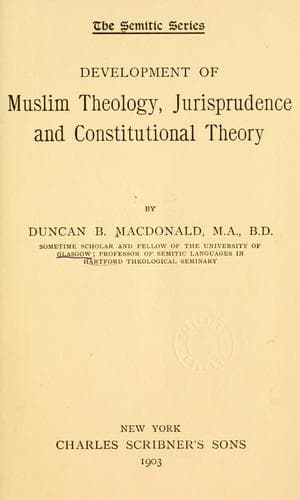
Development of Muslim Theology, Jurisprudence, and Constitutional TheoryMacDonald, Duncan Black
ReligionIslamic
Development of Muslim Theology, Jurisprudence, and Constitutional Theory
MacDonald, Duncan Black
Constitutional law (Islamic law); Islam -- Doctrines -- History; Islam and state -- History; Islamic law -- History
But the most original point in his system is his doctrine of the
names of God, and his basing of that doctrine upon God’s qualities.
The Ash‘arites, he contended with justice, had been guilty of a grave
inconsistency in saying that God was different in nature, qualities,
and actions from all created things, and yet that the human qualities
could be predicated of God, and that men could reason about God’s
nature. He accepted the doctrine of God’s difference (_mukhalafa_)
on highly logical, but, for us, rather startling grounds. The Qur’an
applies to Him the words, “The Most Merciful of those that show mercy,”
but God, evidently, is not merciful. He tortures children with all
manner of painful diseases, with hunger and terror. Mercy, in our human
sense, which is high praise applied to a man, cannot be predicated
of God. What then does the Qur’an mean by those words? Simply that
they—_arhamu-r-rahimin_—are one of God’s names, applied to Him by
Himself and that we have no right to take them as descriptive of a
quality, mercy, and to use them to throw light on God’s nature. They
form one of the Ninety-nine Most Beautiful Names (_al-asma al-husna_)
of which the Prophet has spoken in a tradition. Similarly, we may call
God the Living One (_al hayy_), because He has given us that as one
of His names, not because of any reasoning on our part. Do we not say
that His life is different from that of all other living beings? These
names then, are limited to ninety-nine and no more should be formed,
however full of praise such might be for God, or however directly based
on His actions. He has called Himself _al-Wahib_, the Giver, and so we
may use that term of Him. But He has not called Himself _al-Wahhab_ the
Bountiful Giver, so we may not use that term of Him, though it is one of
praise. Of course, you may describe His action and say that He is the
guider of His saints. But you must not make from that a name, and call
Him simply the Guider. Further, if we regard these names as expressing
qualities in God, we involve multiplicity in God’s nature; there is the
quality and the thing qualified. Here we are back at the old Mu‘tazilite
difficulty and it is intelligible that Ibn Hazm dealt more gently with
the Mu‘tazilites than with the Ash‘arites. The one party were Muslims and
sinned in ignorance—invincible ignorance, a Roman Catholic would call it;
the others were unbelievers. They had turned wilfully from the way. The
Mu‘tazilites had tried to limit the qualities as much as possible. At the
best they had said that they _were_ God’s essence and not in His essence.
Al-Ash‘ari and his school had fairly revelled in qualities and had mapped
out the nature of God with the detail—and daring—of a phrenological chart.
Public-domain text, read in full here on John Shaqi.
Reviews
Reviews
No reviews yet
Be the first to share your thoughts on this work.
Elsewhere in the archive
Join the Discussion
Join the discussion
Sign in to leave a comment or review.
Sign InorCreate an account