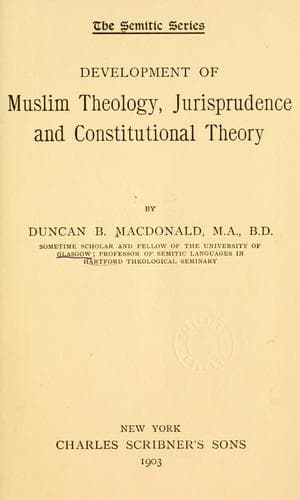
Development of Muslim Theology, Jurisprudence, and Constitutional TheoryMacDonald, Duncan Black
ReligionIslamic
Development of Muslim Theology, Jurisprudence, and Constitutional Theory
MacDonald, Duncan Black
Constitutional law (Islamic law); Islam -- Doctrines -- History; Islam and state -- History; Islamic law -- History
Naturally, Ibn Hazm made his ethical basis the will of God only. God
has willed that this should be a sin and that a good deed. Lying, he
concedes, is always saying what does not agree with the truth. But,
still, God may pronounce that one lie is a sin, and one not. Muslim
ethics, it is true, have never branded lying as sinful in itself.
For the Shi‘ites and their doctrine of an infallible Imam, Ibn Hazm
cannot find strong enough expressions of contempt.
In Ibn Hazm’s time, and he praises God for it, there were but few
Ash‘arites in the West. Theology generally did not find many students. So
things went on till long after his death. To this fiery controversialist
the worst blow of all would have been if he could have known that the
men who were at last to bring his system, in part and for a time, into
public acceptance and repute, were also to complete the conquest of Islam
for the Ash‘arite school. That was still far in the future, and we must
return to the persecution.
The accounts of the persecution which set in are singularly conflicting.
Some assign it to Hanbalite influence; others tell of a Mu‘tazilite wazir
of Tughril Beg. That the traditionalist party was the main force in it
seems certain. In all probability, however, all the other anti-Ash‘arite
sects, from the Mu‘tazilites on, took their own parts. The Ash‘arite
party represented a _via media_ and would be set upon with zest by all
the extremes. They were solemnly cursed from the pulpits and, what
added peculiar insult to it, the Rafidites, an extreme Kharijite sect,
were joined in the same anathema. Al-Juwayni, the greatest theologian
of the time, fled to the Hijaz and gained the title of Imam of the two
Harams (_Imam al-Haramayn_), by living for four years between Mecca and
al-Madina. Al-Qushayri, the author of a celebrated treatise on Sufiism,
was thrown into prison. The Ash‘arite doctors generally were scattered to
the winds. Only with the death of Tughril Beg in 455 did the cloud pass.
His successor, Alp-Arslan, and especially the great wazir, Nizam al-Mulk,
favored the Ash‘arites. In 459 the latter founded the Nizamite Academy
at Baghdad to be a defence of Ash‘arite doctrines. This may fairly be
regarded as the turning-point of the whole controversy. The Hanbalite mob
of Baghdad still continued to make itself felt, but its excesses were
promptly suppressed. In 510 ash-Shahrastani was well received there by
the people, and in 516 the Khalifa himself attended Ash‘arite lectures.
[Sidenote: TRIUMPH OF ASH‘ARISM]
Public-domain text, read in full here on John Shaqi.
Reviews
Reviews
No reviews yet
Be the first to share your thoughts on this work.
Elsewhere in the archive
Join the Discussion
Join the discussion
Sign in to leave a comment or review.
Sign InorCreate an account