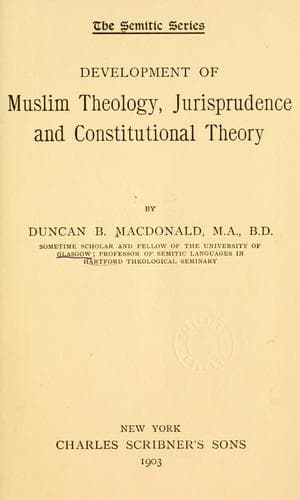
Development of Muslim Theology, Jurisprudence, and Constitutional TheoryMacDonald, Duncan Black
ReligionIslamic
Development of Muslim Theology, Jurisprudence, and Constitutional Theory
MacDonald, Duncan Black
Constitutional law (Islamic law); Islam -- Doctrines -- History; Islam and state -- History; Islamic law -- History
It is needless to spend more time over the other theologians who were
links in the chain between al-Ash‘ari and the Imam al-Haramayn. Their
views wavered, this way and that, only the rationalizing tendency became
stronger and stronger. There was danger that the orthodox system would
fossilize and lose touch with life as that of the Mu‘tazilites had
done. It is true that Sufiism still held its ground. All theologians
practically were touched by it in its simpler form; and the cause of the
higher Sufiism of ecstasy, wonders by saints (_karamat_) and communion of
the individual soul with God had been eloquently and effectively urged
by al-Qushayri (d. 465) in his _Risala_. But in spite of the labors of
so many men of high ability, the religious outlook was growing ever
darker. Keen observers recognized that some change was bound to come.
That it might be an inflowing of new life by a new al-Ash‘ari was their
prayer. It is more than dubious whether even the keenest mind of the
time could have recognized what form the new life must take. They had
not the perspective and could only feel a vague need. But from what has
gone before it will be plain that Islam had again to assimilate to itself
something from without or perish. Such had been its manner of progress
up till now. New opinions had arisen; had become heresies; conflict had
followed; part of the new thought had been absorbed into the orthodox
church; part had been rejected; through it all the life of the church
had gone on in fuller and richer measure, being always, in spite of
everything, the main stream; the heresy itself had slowly dwindled out
of sight. So it had been with Murji’ism; so with Mu‘tazilism. With the
orthodox, tradition (_naql_) still stood fast, but reason (_aql_) had
taken a place beside it. Kalam, in spite of Hanbalite clamors, had become
fairly a part of their system. What was to be the new element, and who
was to be its champion?
CHAPTER IV
Al-Ghazzali, his life, times, and work; Sufiism formally
accepted into Islam.
Public-domain text, read in full here on John Shaqi.
Reviews
Reviews
No reviews yet
Be the first to share your thoughts on this work.
Elsewhere in the archive
Join the Discussion
Join the discussion
Sign in to leave a comment or review.
Sign InorCreate an account