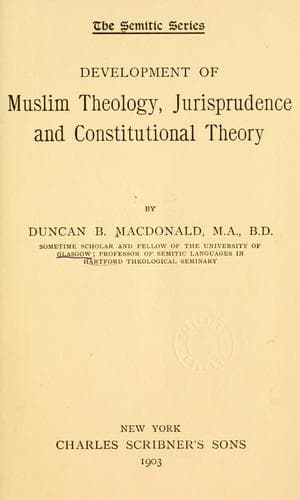
Development of Muslim Theology, Jurisprudence, and Constitutional TheoryMacDonald, Duncan Black
ReligionIslamic
Development of Muslim Theology, Jurisprudence, and Constitutional Theory
MacDonald, Duncan Black
Constitutional law (Islamic law); Islam -- Doctrines -- History; Islam and state -- History; Islamic law -- History
With the time came the man. He was al-Ghazzali, the greatest, certainly
the most sympathetic figure in the history of Islam, and the only teacher
of the after generations ever put by a Muslim on a level with the four
great Imams. The equal of Augustine in philosophical and theological
importance, by his side the Aristotelian philosophers of Islam, Ibn
Rushd and all the rest, seem beggarly compilers and scholiasts. Only
al-Farabi, and that in virtue of his mysticism, approaches him. In his
own person he took up the life of his time on all its sides and with it
all its problems. He lived through them all and drew his theology from
his experience. Systems and classifications, words and arguments about
words, he swept away; the facts of life as he had known them in his own
soul he grasped. When his work was done the revelation of the mystic
(_kashf_) was not only a full part but the basal part in the structure
of Muslim theology. That basis, in spite, or rather on account of the
work of the mutakallims had previously been lacking. Such a scepticism
as their atomic system had practically amounted to, could disprove much
but could prove little. If all the categories but substance and quality
are mere subjectivities, existing in the mind only, what can we know of
things? An ultra-rational basis had to be found and it was found in the
ecstasy of the Sufis. But al-Ghazzali brought another element into fuller
and more effective working. With him passes away the old-fashioned kalam,
a thing of shreds and patches, scraps of metaphysics and logic snatched
up for a moment of need, without grasp of the full sweep of philosophy,
and incapable, in the long run, of meeting it. Even its atomic system is
a philosophy of amateurs, with all their fantastic one-sidedness, their
vigor and rigor. But al-Ghazzali was no amateur. His knowledge and grasp
of the problems and objects of philosophy were truer and more vital
than in any other Muslim up to his time—perhaps after it, too. Islam
has not fully understood him any more than Christendom fully understood
Augustine, but until long after him the horizon of Muslims was wider and
their air clearer for his work. Then came a new scholasticism, reigning
to this day.
So much by way of preface. We must now give some account of the life
and experiences, the ideas and sensations, of this great leader and
reformer. For his life and his work were one. Everything that he thought
and wrote came with the weight and reality of personal experience. He
recognized this connection himself, and has left us a book—the _Munqidh
min ad-dalal_, “Rescuer from Error”—almost unique in Islam, which, in the
form of an apology for the faith, is really an _Apologia pro vita sua_.
This book is our main source for what follows.
[Sidenote: EARLY CAREER; RENUNCIATION]
Public-domain text, read in full here on John Shaqi.
Reviews
Reviews
No reviews yet
Be the first to share your thoughts on this work.
Elsewhere in the archive
Join the Discussion
Join the discussion
Sign in to leave a comment or review.
Sign InorCreate an account