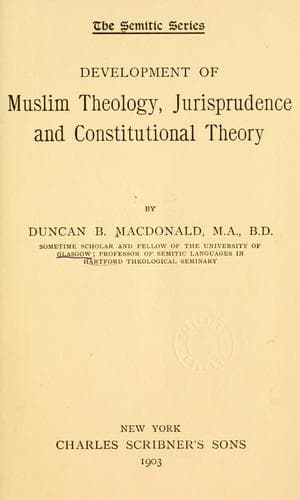
Development of Muslim Theology, Jurisprudence, and Constitutional TheoryMacDonald, Duncan Black
ReligionIslamic
Development of Muslim Theology, Jurisprudence, and Constitutional Theory
MacDonald, Duncan Black
Constitutional law (Islamic law); Islam -- Doctrines -- History; Islam and state -- History; Islamic law -- History
Al-Ghazzali was born at Tus in 450. He lost his father when young and
was educated and brought up by a trusted Sufi friend. He early turned
to the study of theology and canon law, but, as he himself confesses,
it was only because they promised wealth and reputation. Very early
he broke away from _taqlid_, simple acceptance of religious truth on
authority, and he began to investigate theological differences before
he was twenty. His studies were of the broadest, embracing canon law,
theology, dialectic, science, philosophy, logic and the doctrines and
practices of the Sufis. It was a Sufi atmosphere in which he moved, but
their religious fervors do not seem to have laid hold of him. Pride in
his own intellectual powers, ambition and contempt for others of less
ability mastered him. The latter part of his life as a student was spent
at Naysabur as pupil and assistant of the Imam al-Haramayn. Through the
Imam he stood in the apostolic succession of Ash‘arite teachers, being
the fourth from al-Ash‘ari himself. There he remained till the death of
the Imam in 478, when he went out to seek his fortune and found it with
the great wazir, Nizam al-Mulk. By him al-Ghazzali was appointed, in 484,
to teach in the Nizamite Academy at Baghdad. There he had the greatest
success as a teacher and consulting lawyer, and his worldly hopes seemed
safe. But suddenly he was struck down by a mysterious disease. His speech
became hampered; his appetite and digestion failed. His physicians gave
him up; his malady, they said, was mental and could only be mentally
treated. His only hope lay in peace of mind. Then he suddenly quitted
Baghdad, in 488, ostensibly on pilgrimage to Mecca. This flight, for it
was so in effect, of al-Ghazzali was unintelligible to the theologians of
the time; since that time it has marked the greatest epoch in the church
of Islam after the return of al-Ash‘ari.
That it should be unintelligible was natural. No cause could be seen on
the surface, except some possible political complications; the cause in
reality lay in al-Ghazzali’s mind and conscience. He was wandering in the
labyrinth of his time. From his youth he had been a sceptical, ambitious
student, playing with religious influences yet unaffected by them. But
the hollowness of his life was ever present with him and pressing upon
him. Like some with us, he sought to be converted and could not bring
it to pass. His religious beliefs gradually gave way and fell from him,
piece by piece.
Public-domain text, read in full here on John Shaqi.
Reviews
Reviews
No reviews yet
Be the first to share your thoughts on this work.
Elsewhere in the archive
Join the Discussion
Join the discussion
Sign in to leave a comment or review.
Sign InorCreate an account