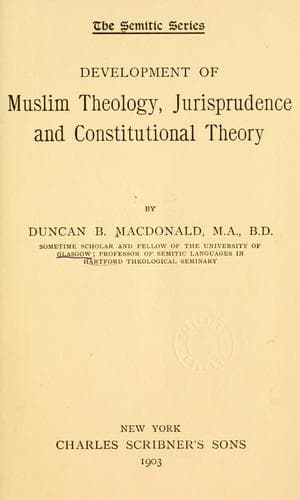
Development of Muslim Theology, Jurisprudence, and Constitutional TheoryMacDonald, Duncan Black
ReligionIslamic
Development of Muslim Theology, Jurisprudence, and Constitutional Theory
MacDonald, Duncan Black
Constitutional law (Islamic law); Islam -- Doctrines -- History; Islam and state -- History; Islamic law -- History
He came next to examine the doctrine of the Ta‘limites. They, a somewhat
outlying wing of the Fatimid propaganda, had come at this time into
alarming prominence. In 483 Hasan ibn as-Sabbah had seized Alamut and
entered on open rebellion. The sect of the Assassins was applying its
principles. But the poison of their teaching was also spreading among
the people. The principle of authority in religion, that only by an
infallible teacher could truth be reached and that such an infallible
teacher existed if he could only be found, was in the air. For
himself, al-Ghazzali found the Ta‘limites and their teaching eminently
unsatisfactory: They had a lesson which they went over parrot-fashion,
but beyond it they were in dense ignorance. The trained theologian and
scholar had no patience with their slackness and shallowness of thought.
He labored long, as ash-Shahrastani later confesses that he, too, did,
to penetrate their mystery and learn something from them; but beyond the
accustomed formulæ there was nothing to be found. He even admitted their
contention of the necessity of a living, infallible teacher, to see what
would follow—but nothing followed. “You admit the necessity of an Imam,”
they would say. “It is your business now to seek him; we have nothing to
do with it.” But though neither al-Ghazzali nor ash-Shahrastani, who died
43 (lunar) years after him, could be satisfied with the Ta‘limites, many
others were. The conflict was hot, and al-Ghazzali himself wrote several
books against them.
[Sidenote: STUDY OF SUFIISM]
The other possibility, the path of the mystic, now lay straight before
him. In the _Munqidh_ he tells us how, when he had made an end of the
Ta‘limites, he began to study the books of the Sufis, without any
suggestion that he had had a previous acquaintance with them and their
practices. But probably this means nothing more than it does when he
speaks in a similar way of studying the scholastic theologians; namely,
that he now took up the study in earnest and with a new and definite
purpose. He therefore read carefully the works of al-Harith al-Muhasibi,
the fragments of al-Junayd, ash-Shibli, and Abu Yazid al-Bistami. He had
also the benefit of oral teaching; but it became plain to him that only
through ecstasy and the complete transformation of the moral being could
he really understand Sufiism. He saw that it consisted in feelings more
than in knowledge, that he must be initiated as a Sufi himself; live
their life and practise their exercises, to attain his goal.
Public-domain text, read in full here on John Shaqi.
Reviews
Reviews
No reviews yet
Be the first to share your thoughts on this work.
Elsewhere in the archive
Join the Discussion
Join the discussion
Sign in to leave a comment or review.
Sign InorCreate an account