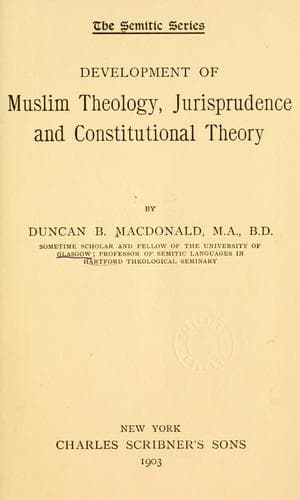
Development of Muslim Theology, Jurisprudence, and Constitutional TheoryMacDonald, Duncan Black
ReligionIslamic
Development of Muslim Theology, Jurisprudence, and Constitutional Theory
MacDonald, Duncan Black
Constitutional law (Islamic law); Islam -- Doctrines -- History; Islam and state -- History; Islamic law -- History
On the way upon which he had gone up to this time, he had gained three
fixed points of faith. He now believed firmly in God, in prophecy, and in
the last judgment. He had also gained the belief that only by detaching
himself from this world, its life, enjoyments, honors, and turning to God
could he be saved in the world to come. He looked on his present life,
his writing and his teaching, and saw of how little value it was in the
face of the great fact of heaven and hell. All he did now was for the
sake of vainglory and had in it no consecration to the service of God. He
felt on the edge of an abyss. The world held him back; his fears urged
him away. He was in the throes of a conversion wrought by terror; his
religion, now and always, in common with all Islam, was other-worldly. So
he remained in conflict with himself for six months from the middle of
488. Finally, his health broke down under the strain. In his feebleness
and overthrow he took refuge with God, as a man at the end of his
resources. God heard him and enabled him to make the needed sacrifices.
He abandoned all and wandered forth from Baghdad as a Sufi. He had put
his brilliant present and brilliant future absolutely behind him; had
given up everything for the peace of his soul. This date, the end of 488,
was the great era in his life; but it marked an era, too, in the history
of Islam. Since al-Ash‘ari went back to the faith of his fathers in 300,
and cursed the Mu‘tazilites and all their works, there had been no such
epoch as this flight of al-Ghazzali. It meant that the reign of mere
scholasticism was over; that another element was to work openly in the
future Church of Islam, the element of the mystical life in God, of the
attainment of truth by the soul in direct vision.
[Sidenote: ON THE PATH OF THE SUFIS]
He went to Syria and gave himself up for two years to the religious
exercises of the Sufis. Then he went on pilgrimage, first to Jerusalem;
then to the tomb of Abraham at Hebron; finally to Mecca and al-Madina.
With this religious duty his life of strict retirement ended. It is
evident that he now felt that he was again within the fold of Islam.
In spite of his former resolution to retire from the world, he was
drawn back. The prayers of his children and his own aspirations broke
in upon him, and though he resolved again and again to return to the
contemplative life, and did often actually do so, yet events, family
affairs, and the anxieties of life, kept continually disturbing him.
Public-domain text, read in full here on John Shaqi.
Reviews
Reviews
No reviews yet
Be the first to share your thoughts on this work.
Elsewhere in the archive
Join the Discussion
Join the discussion
Sign in to leave a comment or review.
Sign InorCreate an account