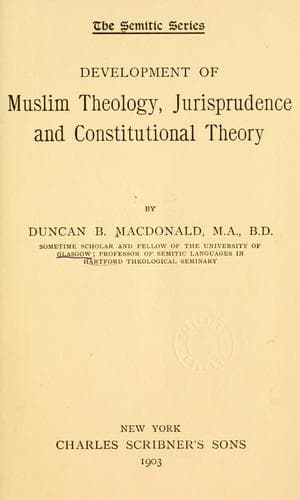
Development of Muslim Theology, Jurisprudence, and Constitutional TheoryMacDonald, Duncan Black
ReligionIslamic
Development of Muslim Theology, Jurisprudence, and Constitutional Theory
MacDonald, Duncan Black
Constitutional law (Islamic law); Islam -- Doctrines -- History; Islam and state -- History; Islamic law -- History
This went on, he tells us, for almost ten years, and in that time there
were revealed to him things that could not be reckoned and the discussion
of which could not be exhausted. He learned that the Sufis were on the
true and only path to the knowledge of God; that neither intelligence
nor wisdom nor science could change or improve their doctrine or their
ethics. The light in which they walk is essentially the same as the light
of prophecy; Muhammad was a Sufi when on his way to be a prophet. There
is none other light to light any man in this world. A complete purifying
of the heart from all but God is their Path; a seeking to plunge the
heart completely in the thought of God, is its beginning, and its end is
complete passing away in God. This last is only its end in relation to
what can be entered upon and grasped by a voluntary effort; in truth, it
is only the first step in the Path, the vestibule to the contemplative
life. Revelations (_mukashafas_, unveilings) came to the disciples from
the very beginning; while awake they see angels and souls of prophets,
hear their voices and gain from them guidance. Then their State (_hal_,
a Sufi technicality for a state of ecstasy) passes from the beholding of
forms to stages where language fails and any attempt to express what is
experienced must involve some error. They reach a nearness to God which
some have fancied to be a _hulul_, fusion of being, others an _ittihad_,
identification, and others a _wusul_, union; but these are all erroneous
ways of indicating the thing. Al-Ghazzali notes one of his books in
which he has explained wherein the error lies. But the thing itself is
the true basis of all faith and the beginning of prophecy; the _karamat_
of the saints lead to the miracles of the prophets. By this means the
possibility and the existence of prophecy can be proved, and then the
life itself of Muhammad proves that he was a prophet. Al-Ghazzali goes
on to deal with the nature of prophecy, and how the life of Muhammad
shows the truth of his mission; but enough has been given to indicate his
attitude and the stage at which he had himself arrived.
Public-domain text, read in full here on John Shaqi.
Reviews
Reviews
No reviews yet
Be the first to share your thoughts on this work.
Elsewhere in the archive
Join the Discussion
Join the discussion
Sign in to leave a comment or review.
Sign InorCreate an account