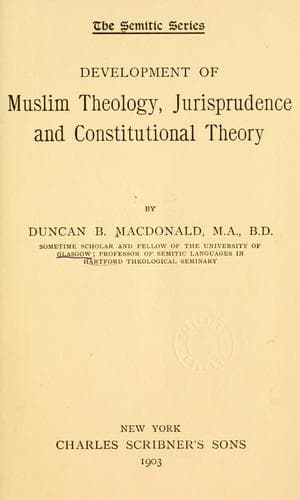
Development of Muslim Theology, Jurisprudence, and Constitutional TheoryMacDonald, Duncan Black
ReligionIslamic
Development of Muslim Theology, Jurisprudence, and Constitutional Theory
MacDonald, Duncan Black
Constitutional law (Islamic law); Islam -- Doctrines -- History; Islam and state -- History; Islamic law -- History
During this ten years he had returned to his native country and to his
children, but had not undertaken public duty as a teacher. Now that was
forced upon him. The century was drawing to a close. Everywhere there
was evident a slackening of religious fervor and faith. A mere external
compliance with the rules of Islam was observed, men even openly defended
such a course. He adduces as an example of this the _Wasiya_ of Ibn Sina.
The students of philosophy went their way, and their conduct shook the
minds of the people; false Sufis abounded, who taught antinomianism;
the lives of many theologians excited scandal; the Ta‘limites were
still spreading. A religious leader to turn the current was absolutely
needed, and his friends looked to al-Ghazzali to take up that duty;
some distinguished saints had dreams of his success; God had promised a
reformer every hundred years and the time was up. Finally, the Sultan
laid a command upon him to go and teach in the academy at Naysabur, and
he was forced to consent. His departure for Naysabur fell at the end of
499, exactly eleven years after his flight from Baghdad. But he did not
teach there long. Before the end of his life we find him back at Tus, his
native place, living in retirement among his disciples, in a Madrasa or
academy for students and a Khanqah or monastery for Sufis.
[Sidenote: THE TAHAFUT]
There he settled down to study and contemplation. We have already seen
what theological position he had reached. Philosophy had been tried and
found wanting. In a book of his called _Tahafut_, or “Destruction,” he
had smitten the philosophers hip and thigh; he had turned, as in earlier
times al-Ash‘ari, their own weapons against them, and had shown that with
their premises and methods no certainty could be reached. In that book
he goes to the extreme of intellectual scepticism, and, seven hundred
years before Hume, he cuts the bond of causality with the edge of his
dialectic and proclaims that we can know nothing of cause or effect,
but simply that one thing follows another. He combats their proof of
the eternity of the world, and exposes their assertion that God is its
creator. He demonstrates that they cannot prove the existence of the
creator or that that creator is one; that they cannot prove that He is
incorporeal, or that the world has any creator or cause at all; that they
cannot prove the nature of God or that the human soul is a spiritual
essence. When he has finished there is no intellectual basis left for
life; he stands beside the Greek sceptics and beside Hume. We are thrown
back on revelation, that given immediately by God to the individual soul
or that given through prophets. All our real knowledge is derived from
these sources. So it was natural that in the latter part of his life he
should turn to the traditions of the Prophet. The science of tradition
must certainly have formed part of his early studies, as of those of all
Public-domain text, read in full here on John Shaqi.
Reviews
Reviews
No reviews yet
Be the first to share your thoughts on this work.
Elsewhere in the archive
Join the Discussion
Join the discussion
Sign in to leave a comment or review.
Sign InorCreate an account