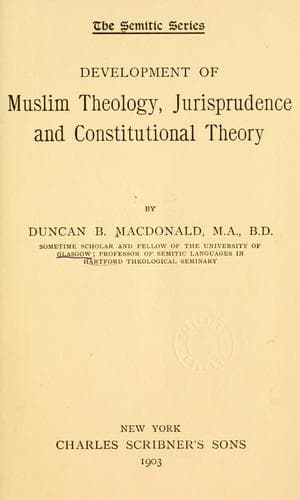
Development of Muslim Theology, Jurisprudence, and Constitutional TheoryMacDonald, Duncan Black
ReligionIslamic
Development of Muslim Theology, Jurisprudence, and Constitutional Theory
MacDonald, Duncan Black
Constitutional law (Islamic law); Islam -- Doctrines -- History; Islam and state -- History; Islamic law -- History
Muslim theologians, but he had not specialized in it; his bent had lain
in quite other directions. His master, the Imam al-Haramayn, had been no
student of tradition; among his many works is not one dealing with that
subject. Now he saw that the truth and the knowledge of the truth lay
there, and he gave himself, with all the energy of his nature, to the new
pursuit.
The end of his wanderings came at Tus, in 505. There he died while
seeking truth in the traditions of Muhammad, as al-Ash‘ari, his
predecessor, had done. The stamp of his personality is ineffaceably
impressed on Islam. The people of his time reverenced him as a saint and
wonder-worker. He himself never claimed to work _karamat_ and always
spoke modestly of the light which he had reached in ecstasy. After
his death legends early began to gather round him, and the current
biographies of him are untrustworthy to a degree. It says much for the
solidity of his work that he did not pass into a misty figure of popular
superstition. But that work remained and remains among his disciples and
in his books. We must now attempt to estimate its bearing and scope.
[Sidenote: VOLITION AS A BASIS]
For him, as for the mutakallims in general, the fundamental thing in the
world and the starting-point of all speculation is will. The philosophers
in their intellectualism might picture God as thought—thought thinking
itself and evolving all things thereby. Their source was Plotinus; that
of the Muslims was the terrific “Be!” of creation. But how can we know
this will of God if we are simply part of what it has produced? In
answering this, al-Ghazzali and his followers have diverged from the rest
of Islam, but not into heresy. Their view is admitted to be a possible
interpretation of Qur’anic passages, if not that commonly held. The soul
of man, al-Ghazzali taught, is essentially different from the rest of
the created things. We read in the Qur’an (xv, 29; xxxviii, 72) that God
breathed into man of His spirit (_ruh_). This is compared with the rays
of the sun reaching a thing on the earth and warming it. In virtue of
this, the soul of man is different from everything else in the world. It
is a spiritual substance (_jawhar ruhani_), has no corporeality, and is
not subject to dimension, position or locality. It is not in the body or
outside of the body; to apply such categories to it is as absurd as to
speak of the knowledge or ignorance of a stone. Though created, it is
not shaped; it belongs to the spiritual world and not to this world of
sensible things. It contains some spark of the divine and it is restless
till it rests again in that primal fire; but, again, it is recorded in
tradition that the Prophet said, “God Most High created Adam in His own
form (_sura_).” Al-Ghazzali takes that to mean that there is a likeness
between the spirit of man and God in essence, quality, and actions.
Further, the spirit of man rules the body as God rules the world.
Public-domain text, read in full here on John Shaqi.
Reviews
Reviews
No reviews yet
Be the first to share your thoughts on this work.
Elsewhere in the archive
Join the Discussion
Join the discussion
Sign in to leave a comment or review.
Sign InorCreate an account