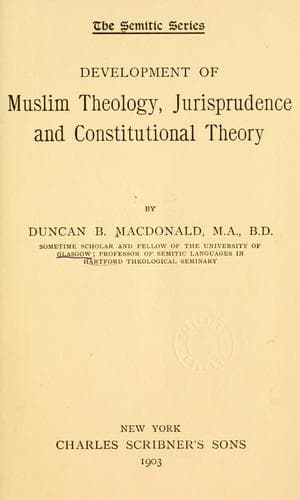
Development of Muslim Theology, Jurisprudence, and Constitutional TheoryMacDonald, Duncan Black
ReligionIslamic
Development of Muslim Theology, Jurisprudence, and Constitutional Theory
MacDonald, Duncan Black
Constitutional law (Islamic law); Islam -- Doctrines -- History; Islam and state -- History; Islamic law -- History
Man’s body is a microcosm beside the macrocosm of this world, and they
correspond, part by part. Is, then, God simply the _anima mundi_? No,
because He is the creator of all by His will, the sustainer and destroyer
by His will. Al-Ghazzali comes to this by a study of himself. His primary
conception is, _volo ergo sum_. It is not thought which impresses him,
but volition. From thought he can develop nothing; from will can come the
whole round universe. But if God, the Creator, is a Willer, so, too, is
the soul of man. They are kin, and, therefore, man can know and recognize
God. “He who knows his own soul, knows his Lord,” said another tradition.
This view of the nature of the soul is essential to the Sufi position
and is probably borrowed from it. But there are in it two possibilities
of heresy, if the view be pushed any further. It tends (1) to destroy
the important Muslim dogma of God’s Difference (_mukhalafa_) from all
created things, and (2) to maintain that the souls of men are partakers
of the divine nature and will return to it at death. Al-Ghazzali labored
to safeguard both dangers, but they were there and showed themselves
in time. Just as the Aristotelian + neo-Platonic philosophers reached
the position that the universe with all its spheres was God, so, later,
Sufis came to the other pantheistic position that God was the world.
Before the atomic scholastics the same danger also lay. It is part of
the irony of the history of Muslim theology that the very emphasis on
the transcendental unity should lead thus to pantheism. Al-Ghazzali’s
endeavor was to strike the _via media_. The Hegelian Trinity might have
appealed to him.
[Sidenote: DIVINE ORIGIN OF SCIENCES]
Public-domain text, read in full here on John Shaqi.
Reviews
Reviews
No reviews yet
Be the first to share your thoughts on this work.
Elsewhere in the archive
Join the Discussion
Join the discussion
Sign in to leave a comment or review.
Sign InorCreate an account