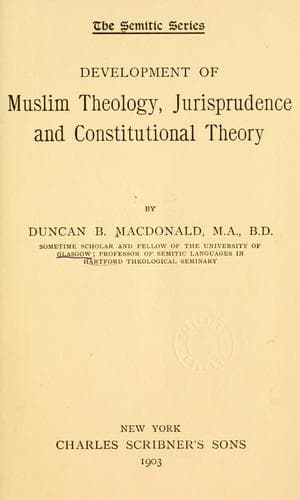
Development of Muslim Theology, Jurisprudence, and Constitutional TheoryMacDonald, Duncan Black
ReligionIslamic
Development of Muslim Theology, Jurisprudence, and Constitutional Theory
MacDonald, Duncan Black
Constitutional law (Islamic law); Islam -- Doctrines -- History; Islam and state -- History; Islamic law -- History
To return, his views on science, as we have already seen, were the same
as those of the contemporary students of natural philosophy. Their
teachings he accepted, and, so far, he can be compared to a theologian
of the present day, who accepts evolution and explains it to suit
himself. His world was framed on what is commonly called the Ptolemaic
system. He was no flat-earth man like the present Ulama of Islam; God
had “spread out the earth like a carpet,” but that did not hinder him
from regarding it as a globe. Around it revolve the spheres of the seven
planets and that of the fixed stars; Alphonso the Wise had not yet added
the crystalline sphere and the _primum mobile_. All that astronomers and
mathematicians teach us of the laws under which these bodies move is
to be accepted. Their theory of eclipses and of other phenomena of the
heavens is true, whatever the ignorant and superstitious may clamor. Yet
it is to be remembered that the most important facts and laws have been
divinely revealed. As the weightiest truths of medicine are to be traced
back to the teaching of the prophets, so there are conjunctions in the
heavens which occur only once in a thousand years and which man can yet
calculate because God has taught him their laws. And all this structure
of the heavens and the earth is the direct work of God, produced out of
nothing by His will, guided by His will, ever dependent for existence on
His will, and one day to pass away at His command. So al-Ghazzali joins
science and revelation. Behind the order of nature lies the personal,
omnipotent God who says, “Be!” and it is. The things of existence do not
proceed from Him by any emanation or evolution, but are produced directly
by Him.
[Sidenote: THE THREE WORLDS]
Public-domain text, read in full here on John Shaqi.
Reviews
Reviews
No reviews yet
Be the first to share your thoughts on this work.
Elsewhere in the archive
Join the Discussion
Join the discussion
Sign in to leave a comment or review.
Sign InorCreate an account