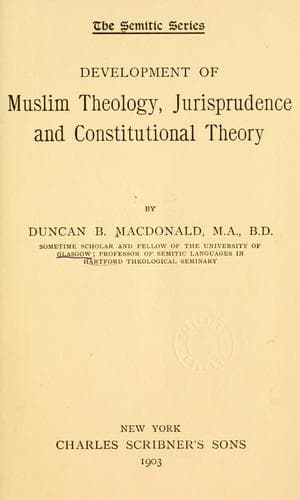
Development of Muslim Theology, Jurisprudence, and Constitutional TheoryMacDonald, Duncan Black
ReligionIslamic
Development of Muslim Theology, Jurisprudence, and Constitutional Theory
MacDonald, Duncan Black
Constitutional law (Islamic law); Islam -- Doctrines -- History; Islam and state -- History; Islamic law -- History
Further, there is another side of al-Ghazzali’s attitude toward the
physical universe that deserves attention, but which is very difficult
to grasp or express. Perhaps it may be stated thus: Existence has
three modes; there is existence in the _alam al-mulk_, in the _alam
al-jabarut_, and in the _alam al-malakut_. The first is this world of
ours which is apparent to the senses; it exists by the power (_qudra_)
of God, one part proceeding from another in constant change. The _alam
al-malakut_ exists by God’s eternal decree, without development,
remaining in one state without addition or diminution. The _alam
al-jabarut_ comes between these two; it seems externally to belong to
the first, but in respect of the power of God which is from all eternity
(_al-qudra al-azaliya_) it is included in the second. The soul (_nafs_)
belongs to the _alam al-malakut_, is taken from it and returns to it. In
sleep and in ecstasy, even in this world, it can come into contact with
the world from which it is derived. This is what happens in dreams—“sleep
is the brother of death,” says al-Ghazzali; and thus, too, the saints
and the prophets attain divine knowledge. Some angels belong to the
world of _malakut_; some to that of _jabarut_, apparently those who
have shown themselves here as messengers of God. The things in the
heavens, the preserved tablet, the pen, the balance, etc., belong to the
world of _malakut_. On the one hand, these are not sensible, corporeal
things, and, on the other, these terms for them are not metaphors. Thus
al-Ghazzali avoids the difficulty of Muslim eschatology with its bizarre
concreteness. He rejects the right to allegorize—these things are real,
actual; but he relegates them to this world of _malakut_. Again, the
Qur’an, Islam, and Friday (the day of public worship) are personalities
in the world of _malakut_ and _jabarut_. So, too, the world of _mulk_
must appear as a personality at the bar of these other worlds at the last
day. It will come as an ugly old woman, but Friday as a beautiful young
bride. This personal Qur’an belongs to the world of _jabarut_, but Islam
to that of _malakut_.
Public-domain text, read in full here on John Shaqi.
Reviews
Reviews
No reviews yet
Be the first to share your thoughts on this work.
Elsewhere in the archive
Join the Discussion
Join the discussion
Sign in to leave a comment or review.
Sign InorCreate an account