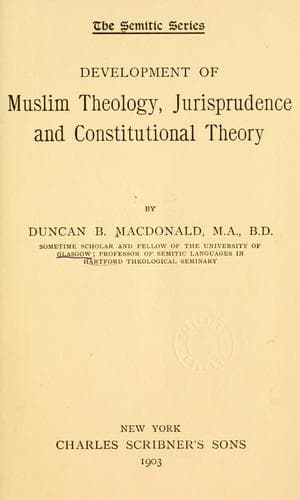
Development of Muslim Theology, Jurisprudence, and Constitutional TheoryMacDonald, Duncan Black
ReligionIslamic
Development of Muslim Theology, Jurisprudence, and Constitutional Theory
MacDonald, Duncan Black
Constitutional law (Islamic law); Islam -- Doctrines -- History; Islam and state -- History; Islamic law -- History
But just as those three worlds are not thought of as separate in time,
so they are not separate in space. They are not like the seven heavens
and seven earths of Muslim literalists, which stand, story-fashion, one
above the other. Rather they are, as expressed above, modes of existence,
and might be compared to the speculations on another life in space of n
dimensions, framed, from a very different starting-point and on a basis
of pure physics, by Balfour Stewart and Tait in their “Unseen Universe.”
On another side they stand in close kinship to the Platonic world of
ideas, whether through neo-Platonism or more immediately. Sufiism at its
best, and when stripped of the trappings of Muslim tradition and Qur’anic
exegesis, has no reason to shrink from the investigation either of the
physicist or of the metaphysician. And so it is not strange to find that
all Muslim thinkers have been tinged with mysticism to a greater or less
degree, though they may not all have embraced formal Sufiism and accepted
its vocabulary and system. This is true of al-Farabi, who was avowedly a
Sufi; true also of Ibn Sina, who, though nominally an Aristotelian, was
essentially a neo-Platonist, and admitted the possibility of intercourse
with superior beings and with the Active Intellect, of miracles and
revelations; true even of Ibn Rushd, who does not venture to deny the
immediate knowledge of the Sufi saints, but only argues that experience
of it is not sufficiently general to be made a basis for theological
science.
In ethics, as we have already seen, the position of al-Ghazzali is a
simple one. All our laws and theories upon the subject, the analysis of
the qualities of the mind, good and bad, the tracing of hidden defects
to their causes—all these things we owe to the saints of God to whom
God Himself has revealed them. Of these there have been many at all
times and in all countries, and without them and their labors and the
light which God has vouchsafed to them, we could never know ourselves.
Here, as everywhere, comes out al-Ghazzali’s fundamental position that
the ultimate source of all knowledge is revelation from God. It may
be major revelation, through accredited prophets who come forward as
teachers, divinely sent and supported by miracles and by the evident
truth of their message appealing to the human heart, or it may be minor
revelation—subsidiary and explanatory—through the vast body of saints of
different grades, to whom God has granted immediate knowledge of Himself.
Where the saints leave off, the prophets begin; and, apart from such
teaching, man, even in physical science, would be groping in the dark.
[Sidenote: AGNOSTIC ATTITUDE]
Public-domain text, read in full here on John Shaqi.
Reviews
Reviews
No reviews yet
Be the first to share your thoughts on this work.
Elsewhere in the archive
Join the Discussion
Join the discussion
Sign in to leave a comment or review.
Sign InorCreate an account