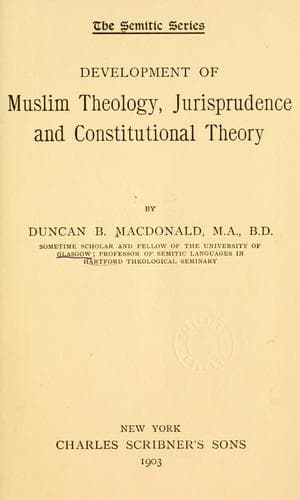
Development of Muslim Theology, Jurisprudence, and Constitutional TheoryMacDonald, Duncan Black
ReligionIslamic
Development of Muslim Theology, Jurisprudence, and Constitutional Theory
MacDonald, Duncan Black
Constitutional law (Islamic law); Islam -- Doctrines -- History; Islam and state -- History; Islamic law -- History
This position becomes still more prominent in his philosophical system.
His agnostic attitude toward the results of pure thought has been already
sketched. It is essentially the same as that taken up by Mansel in his
Bampton lectures on “The Limits of Religious Thought.” Mansel, a pupil
and continuator of Hamilton, developed and emphasized Hamilton’s doctrine
of the relativity of knowledge, and applied it to theology, maintaining
that we cannot know or think of the absolute and infinite, but only of
the relative and finite. Hence, he went on to argue, we can have no
positive knowledge of the attributes of God. This, though disguised by
the methods and language of scholastic philosophy, is al-Ghazzali’s
attitude in the _Tahafut_. Mansel’s opponents said that he was like a man
sitting on the branch of a tree and sawing off his seat. Al-Ghazzali, for
the support of his seat, went back to revelation, either major, in the
books sent down to the prophets, or minor, in the personal revelations
of God’s saints. Further, it was not only in the Muslim schools that
this attitude toward philosophy prevailed. Yehuda Halevi (d. A.D. 1145;
al-Ghazzali, d. 1111) also maintains in his _Kusari_ the insufficiency of
philosophy in the highest questions of life, and bases religious truth on
the incontrovertible historical facts of revelation. And Maimonides (d.
A.D. 1204) in his _Moreh Nebuchim_ takes essentially the same position.
Of his views on dogmatic theology little need be said. Among modern
theologians he stands nearest to Ritschl. Like Ritschl, he rejects
metaphysics and opposes the influence of any philosophical system on
his theology. The basis must be religious phenomena, simply accepted
and correlated. Like Ritschl, too, he was emphatically ethical in his
attitude; he lays stress on the _value for us_ of a doctrine or a piece
of knowledge. Our source of religious knowledge is revelation, and
beyond a certain point we must not inquire as to the how and why of that
knowledge. To do so would be to enter metaphysics and the danger-zone
where we lose touch with vital realities and begin to use mere words. On
one point he goes beyond Ritschl, and, on another, Ritschl goes beyond
him. In his devotion to the facts of the religious consciousness Ritschl
did not go so far as to become a mystic, indeed rejected mysticism with
a conscious indignation; al-Ghazzali did become a mystic. But, on the
other hand, Ritschl refused absolutely to enter upon the nature of God or
upon the divine attributes—all that was mere metaphysics and heathenism;
al-Ghazzali did not so far emancipate himself, and his only advance was
to keep the doctrine on a strictly Qur’anic basis. So it stands written;
not, so man is compelled by the nature of things to think.
[Sidenote: WORK AND INFLUENCE]
Public-domain text, read in full here on John Shaqi.
Reviews
Reviews
No reviews yet
Be the first to share your thoughts on this work.
Elsewhere in the archive
Join the Discussion
Join the discussion
Sign in to leave a comment or review.
Sign InorCreate an account