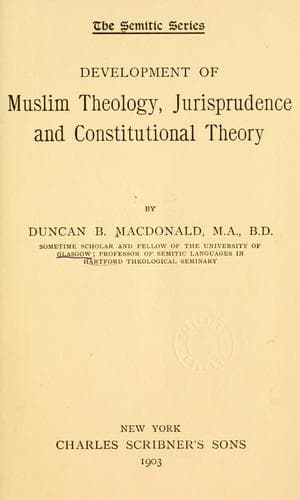
Development of Muslim Theology, Jurisprudence, and Constitutional TheoryMacDonald, Duncan Black
ReligionIslamic
Development of Muslim Theology, Jurisprudence, and Constitutional Theory
MacDonald, Duncan Black
Constitutional law (Islamic law); Islam -- Doctrines -- History; Islam and state -- History; Islamic law -- History
His work and influence in Islam may be summed up briefly as follows:
_First_, he led men back from scholastic labors upon theological
dogmas to living contact with, study and exegesis of, the Word and
the traditions. What happened in Europe when the yoke of mediæval
scholasticism was broken, what is happening with us now, happened in
Islam under his leadership. He could be a scholastic with scholastics,
but to state and develop theological doctrine on a Scriptural basis was
emphatically his method. We should now call him a Biblical theologian.
_Second_, in his teaching and moral exhortations he reintroduced the
element of fear. In the _Munqidh_ and elsewhere he lays stress on the
need of such a striking of terror into the minds of the people. His was
no time, he held, for smooth, hopeful preaching; no time for optimism
either as to this world or the next. The horrors of hell must be kept
before men; he had felt them himself. We have seen how other-worldly
was his own attitude, and how the fear of the Fire had been the supreme
motive in his conversion; and so he treated others.
_Third_, it was by his influence that Sufiism attained a firm and assured
position in the Church of Islam.
_Fourth_, he brought philosophy and philosophical theology within the
range of the ordinary mind. Before his time they had been surrounded,
more or less, with mystery. The language used was strange; its vocabulary
and terms of art had to be specially learned. No mere reader of the
Arabic of the street or the mosque or the school could understand at once
a philosophical tractate. Greek ideas and expressions, passing through a
Syriac version into Arabic, had strained to the uttermost the resources
of even that most flexible tongue. A long training had been thought
necessary before the elaborate and formal method of argumentation could
be followed. All this al-Ghazzali changed, or at least tried to change.
His _Tahafut_ is not addressed to scholars only; he seeks with it a wider
circle of readers, and contends that the views, the arguments, and the
fallacies of the philosophers should be perfectly intelligible to the
general public.
Public-domain text, read in full here on John Shaqi.
Reviews
Reviews
No reviews yet
Be the first to share your thoughts on this work.
Elsewhere in the archive
Join the Discussion
Join the discussion
Sign in to leave a comment or review.
Sign InorCreate an account