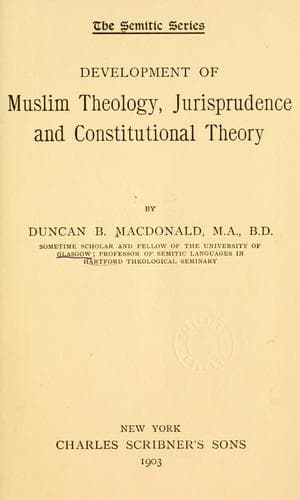
Development of Muslim Theology, Jurisprudence, and Constitutional TheoryMacDonald, Duncan Black
ReligionIslamic
Development of Muslim Theology, Jurisprudence, and Constitutional Theory
MacDonald, Duncan Black
Constitutional law (Islamic law); Islam -- Doctrines -- History; Islam and state -- History; Islamic law -- History
Of these four phases of al-Ghazzali’s work, the first and the third
are undoubtedly the most important. He made his mark by leading Islam
back to its fundamental and historical facts, and by giving a place
in its system to the emotional religious life. But it will have been
noticed that in none of the four phases was he a pioneer. He was not
a scholar who struck out a new path, but a man of intense personality
who entered on a path already blazed and made it the common highway. We
have here his character. Other men may have been keener logicians, more
learned theologians, more gifted saints; but he, through his personal
experiences, had attained so overpowering a sense of the divine realities
that the force of his character—once combative and restless, now narrowed
and intense—swept all before it, and the Church of Islam entered on a new
era of its existence.
So much space it has been necessary to give to this great man. Islam has
never outgrown him, has never fully understood him. In the renaissance
of Islam which is now rising to view his time will come and the new life
will proceed from a renewed study of his works.
[Sidenote: LATER ASH‘ARITES]
From this time on, the Ash‘arites may be fairly regarded as the dominant
school so far as the East is concerned. Saladin (d. 589) did much to aid
in the establishment of this hegemony. He was a devout Muslim with the
taste of an amateur for theological literature. Anecdotes tell how he had
a special little catechism composed, and used himself to instruct his
children in it. He founded theological academies in Egypt at Alexandria
and Cairo, the first there except the Fatimid Hall of Science. One of the
few blots on his name is the execution of the pantheistic Sufi, Shihab
ad-Din as-Suhrawardi, at Aleppo in 587. Meanwhile, in the farther East,
Fakhr ad-Din ar-Razi (d. 606) was writing his great commentary on the
Qur’an, the _Mafatih al-Ghayb_, “The Keys of the Unseen,” and carrying
on the work of al-Ghazzali. The title of his commentary itself shows the
dash of mysticism in his teaching, and he was in correspondence with Ibn
Arabi, the arch-Sufi of the time. He studied philosophy, too, commented
on works of Ibn Sina, and fought the philosophers on their own ground
as al-Ghazzali had done. Kalam and philosophy are now, in the eyes of
the theologians, a true philosophy and a false. Philosophy has taken the
place of Mu‘tazilism and the other heresies. The enemies of the faith
are outside its pale, and the scholasticizing of philosophy goes on
steadily. According to some, a new stage was marked by al-Baydawi (d.
685), who confused inextricably philosophy and kalam, but the newness
can have been comparative only. A century later al-Iji (d. 756) writes
a book, _al-Mawaqif_, on kalam, half of which is given to metaphysics
and the other half to dogmatics. At-Taftazani is another name worthy of
mention. He died in 791, after a laborious life as a controversialist and
commentator.
Public-domain text, read in full here on John Shaqi.
Reviews
Reviews
No reviews yet
Be the first to share your thoughts on this work.
Elsewhere in the archive
Join the Discussion
Join the discussion
Sign in to leave a comment or review.
Sign InorCreate an account