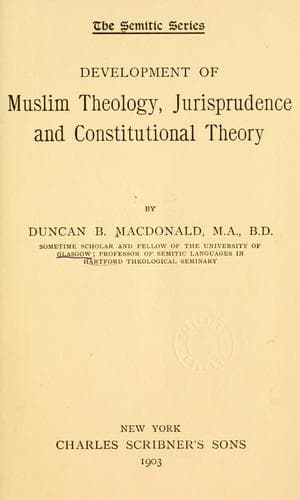
Development of Muslim Theology, Jurisprudence, and Constitutional TheoryMacDonald, Duncan Black
ReligionIslamic
Development of Muslim Theology, Jurisprudence, and Constitutional Theory
MacDonald, Duncan Black
Constitutional law (Islamic law); Islam -- Doctrines -- History; Islam and state -- History; Islamic law -- History
When we reach Ibn Khaldun (d. 808), the first philosophical
historian and the greatest until the nineteenth century of our era, we
find that kalam has fallen again from its high estate. It has become a
scholastic discipline, useful only to repel the attacks of heretics and
unbelievers; and of heretics, says Ibn Khaldun, there are now none left.
Reason, he goes on, cannot grasp the nature of God; cannot weigh His
unity nor measure His qualities. God is unknowable and we must accept
what we are told about Him by His prophets. Such was the result of the
destruction of philosophy in Islam.
CHAPTER V
Islam in the West; Ibn Tumart and the Muwahhids; philosophy in
the West under Muwahhid protection; Ibn Bajja; Ibn Tufayl; Ibn
Rushd; Ibn Arabi; Ibn Sab‘in.
We have now anticipated one of the strangest and most characteristic
figures and movements in the history of Islam. The preceding account,
except as relates to Ibn Khaldun, has told of the triumphs of the
Ash‘arites in the East only. In the West the movement was slower, and to
it we must now turn. The Maghrib—the Occident, as the Arabs called all
North Africa beyond Egypt—had been slow from the first to take on the
Muslim impress. The invading army had fought its way painfully through,
but the Berber tribes remained only half subdued and one-tenth Islamized.
Egypt was conquered in A.H. 20, and Samarqand had been reached in 56;
but it was not till 74 that the Muslims were at Carthage. And even then
and for long after there arose insurrection after insurrection, and the
national spirit of the Berbers remained unbroken. Broadly, but correctly,
Islam in North Africa for more than three centuries was a failure. The
tribal constitutions of the Berbers were unaffected by the conception
of the Khalifate and their primitive religious aspirations by the Faith
of Muhammad. Not till the possibility came to them to construct Muslim
states out of their own tribes did their opposition begin to weaken.
And then it was rather political Islam that had weakened. When the
Fatimids conquered Egypt in 356 and moved the seat of their empire from
al-Mahdiya to the newly founded Cairo, Islam assumed a new meaning for
North Africa. The Fatimid empire there quickly melted away, and in its
place arose several independent states, Berber in blood though claiming
Arab descent and bearing Arab names. Islam no longer meant foreign
oppression, and it began at last to make its way. Again, in the preceding
period of insurrection the Berber leaders had frequently appeared in the
guise and with the claim of prophets, men miraculously gifted and with
a message from God. These wild tribesmen, with all their fanaticism for
their own tribal liberties, have always been peculiarly accessible to the
genius which claims its mission from heaven. So they had taken up the
Fatimid cause and worshipped Ubayd Allah the Mahdi. And so they continued
thereafter, and still continue to be swayed by saints, darwishes, and
Public-domain text, read in full here on John Shaqi.
Reviews
Reviews
No reviews yet
Be the first to share your thoughts on this work.
Elsewhere in the archive
Join the Discussion
Join the discussion
Sign in to leave a comment or review.
Sign InorCreate an account