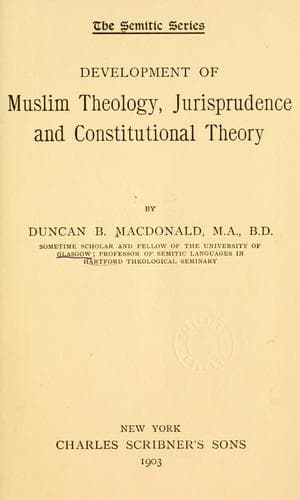
Development of Muslim Theology, Jurisprudence, and Constitutional TheoryMacDonald, Duncan Black
ReligionIslamic
Development of Muslim Theology, Jurisprudence, and Constitutional Theory
MacDonald, Duncan Black
Constitutional law (Islamic law); Islam -- Doctrines -- History; Islam and state -- History; Islamic law -- History
prophets of all degrees of insanity and cunning. The latest case in
point is that of the Shaykh as-Sanusi, with whom we have already dealt.
As time went on, there came a change in these prophet-led risings and
saint-founded states. They gradually slipped over from being frankly
anti-Muhammadan, if also close imitations of Muhammad’s life and methods,
to being equally frankly Muslim. The theology of Islam easily afforded
them the necessary point of connection. All that the prophet of the day
need do was to claim the position of the Mahdi, that Guided One, who
according to the traditions of Muhammad was to come before the last day,
when the earth shall be filled with violence, and to fill it again with
righteousness. It was easy for each new Mahdi to select from the vast and
contradictory mass of traditions in Muslim eschatology those which best
fitted his person and his time. To the story and the doctrine of one of
these we now come.
[Sidenote: IBN TUMART]
At the beginning of the sixth century a certain Berber student of
theology, Ibn Tumart by name, travelled in the East in search of
knowledge. An early and persistent western tradition asserts that he
was a favorite pupil of al-Ghazzali’s, and was marked out by him as
showing the signs of a future founder of empire. This may be taken for
what it is worth. What is certain is that Ibn Tumart went back to the
Maghrib and there brought about the triumph of a doctrine which was
derived, if modified, from that of the Ash‘arites. Previously all kalam
had been under a cloud in the West. Theological studies had been closely
limited to _fiqh_, or canon law, and that of the narrowed school of
Malik ibn Anas. Even the Qur’an and the collections of traditions had
come to be neglected in favor of systematized law-books. The revolt of
Ibn Hazm against this had apparently accomplished little. It had been
too one-sided and negative, and had lacked the weight of personality
behind it. Ibn Hazm had assailed the views of others with a wealth of
vituperative language. But he had been a controversialist only. There
is a story, tolerably well authenticated, that the books of al-Ghazzali
were solemnly condemned by the Qadis of Cordova, and burnt in public.
Yet, against that is to be set that all the Spanish theologians did not
approve of this violence.
[Sidenote: A ZAHIRITE IMAMITE]
Public-domain text, read in full here on John Shaqi.
Reviews
Reviews
No reviews yet
Be the first to share your thoughts on this work.
Elsewhere in the archive
Join the Discussion
Join the discussion
Sign in to leave a comment or review.
Sign InorCreate an account