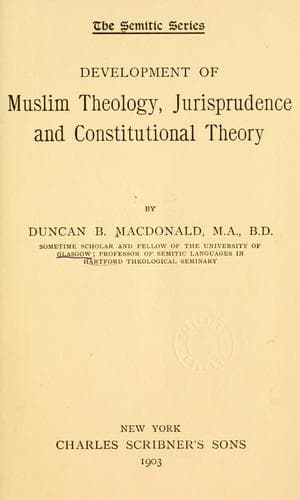
Development of Muslim Theology, Jurisprudence, and Constitutional TheoryMacDonald, Duncan Black
ReligionIslamic
Development of Muslim Theology, Jurisprudence, and Constitutional Theory
MacDonald, Duncan Black
Constitutional law (Islamic law); Islam -- Doctrines -- History; Islam and state -- History; Islamic law -- History
The book by which his name has lived, and which has had strange haps,
is the romance of _Hayy ibn Yaqzan_, “The Living One, Son of the
Waking One.” In it he conceives two islands, the one inhabited and the
other not. On the inhabited island we have conventional people living
conventional lives, and restrained by a conventional religion of rewards
and punishments. Two men there, Salaman and Asal, have raised themselves
to a higher level of self-rule. Salaman adapts himself externally to the
popular religion and rules the people; Asal, seeking to perfect himself
still further in solitude, goes to the other island. But there he finds a
man, Hayy ibn Yaqzan, who has lived alone from infancy and has gradually,
by the innate and uncorrupted powers of the mind, developed himself to
the highest philosophic level and reached the Vision of the Divine. He
has passed through all the stages of knowledge until the universe lies
clear before him, and now he finds that his philosophy thus reached,
without prophet or revelation, and the purified religion of Asal are
one and the same. The story told by Asal of the people of the other
island sitting in darkness stirs his soul and he goes forth to them as a
missionary. But he soon learns that the method of Muhammad was the true
one for the great masses, and that only by sensuous allegory and concrete
things could they be reached and held. He retires to his island again to
live the solitary life.
The bearing of this on the system of the Muwahhids cannot be mistaken.
If it is a criticism of the finality of historical revelation, it is
also a defence of the attitude of the Muwahhids toward both people and
philosophers. By the favor of Abu Ya‘qub, Ibn Tufayl had practically been
able to live on an island and develop himself by study. So, too, Abu
Ya‘qub might stand for the enlightened but practical Salaman. Yet the
meaning evidently is that between them they failed and must fail. There
could only be a solitary philosopher here and there, and happy for him
if he found a princely patron. The people which knew not the truth were
accursed. Perhaps, rather, they were children and had to be humored and
guided as such in an endless childhood.
Public-domain text, read in full here on John Shaqi.
Reviews
Reviews
No reviews yet
Be the first to share your thoughts on this work.
Elsewhere in the archive
Join the Discussion
Join the discussion
Sign in to leave a comment or review.
Sign InorCreate an account