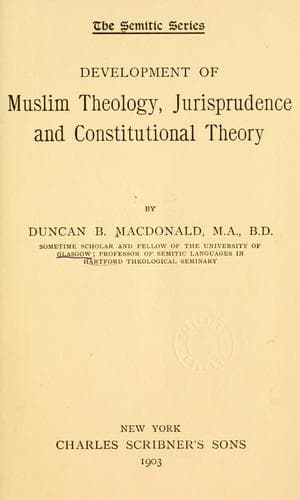
Development of Muslim Theology, Jurisprudence, and Constitutional TheoryMacDonald, Duncan Black
ReligionIslamic
Development of Muslim Theology, Jurisprudence, and Constitutional Theory
MacDonald, Duncan Black
Constitutional law (Islamic law); Islam -- Doctrines -- History; Islam and state -- History; Islamic law -- History
It is evident that such a solitary possessor of truth had two courses
open to him. He could either busy himself in his studies and exercises,
as had done Ibn Bajja and Ibn Tufayl, or he could boldly enter public
life and trust to his dialectic ingenuity and resource—perhaps, also, to
his plasticity of conscience—to carry him past all whispers of heresy
and unbelief. The latter course was chosen by Ibn Rushd. He was born
at Cordova, in 520, of a family of jurists and there studied law. From
his legal studies only a book on the law of inheritance has reached
us, and it, though frequently commented on, has never been printed. In
548 he was presented to Abu Ya‘qub by Ibn Tufayl and encouraged by him
in the study of philosophy. In it his greatest work was done. In spite
of the shreds and patches of neo-Platonism which clung to him, he was
the greatest mediæval commentator on Aristotle. It is only part of the
eternal puzzle of the Muslim mind that the utility of Greek for a student
of Aristotle seems never to have struck him. Thereafter he acted as judge
in different places in Spain and was court physician for a short time
in 578 to Abu Ya‘qub. In 575 he had written his tractates, to which we
shall come immediately, mediating between philosophy and theology. Toward
the end of his life he was condemned by Abu Yusuf al-Mansur for heresy
and banished from Cordova. This was in all likelihood a truckling on the
part of al-Mansur to the religious prejudices of the people of Spain,
who were probably of stiffer orthodoxy than the Berbers. He was in Spain,
at Cordova, at the time, and was engaged in carrying on a religious war
with the Christians. On his return to Morocco the decree of exile was
recalled and Ibn Rushd restored to favor. We find him again at the court
in Morocco, and he died there in 595.
Public-domain text, read in full here on John Shaqi.
Reviews
Reviews
No reviews yet
Be the first to share your thoughts on this work.
Elsewhere in the archive
Join the Discussion
Join the discussion
Sign in to leave a comment or review.
Sign InorCreate an account