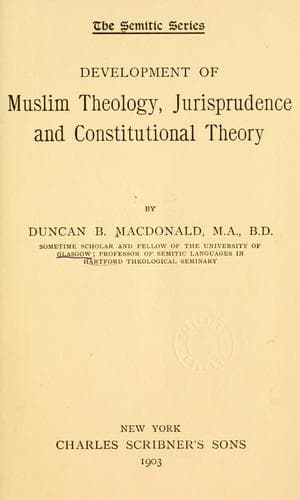
Development of Muslim Theology, Jurisprudence, and Constitutional TheoryMacDonald, Duncan Black
ReligionIslamic
Development of Muslim Theology, Jurisprudence, and Constitutional Theory
MacDonald, Duncan Black
Constitutional law (Islamic law); Islam -- Doctrines -- History; Islam and state -- History; Islamic law -- History
This is not the place to enter upon Ibn Rushd’s philosophical system.
He was a thorough-going Aristotelian, as he knew Aristotle. That was
probably much better than any of his predecessors; but even he had
not got clear from the fatal influence of Plotinus. Above all, he is
essentially a theologian just as much as they. In Aristotle there had
been given what was to all intents a philosophical revelation. Only in
the knowledge and acceptance of it could truth and life be found. And
some must reach it; one at least there must always be. If a thing is
not seen by someone it has existed in vain; which is impossible. If
someone at least does not know the truth, it also has existed in vain,
which is still more impossible. That is Ibn Rushd’s way of saying that
the _esse_ is the _percipi_ and that there must be a perceiver. And he
has unlimited faith in his means of reaching that Truth—only by such
capitalization can we express his theologic attitude. The logic of
Aristotle is infallible and can break through to the supreme good itself.
Ecstasy and contemplation play no part with him; there he separates from
Ibn Tufayl. Such intercourse with the Active Intellect may exist; but it
is too rare to be taken into account. Obviously, Ibn Rushd himself, who
to himself was the percipient of truth for his age, had never reached
that perception. Solitary meditation he cannot away with; for him the
market-place and contact with men; there he parts with Ibn Bajja. In
truth, he is nearer to the life in life of Ibn Sina, and that, perhaps,
explains his constant attacks on the Persian _bon vivant_.
[Sidenote: ATTACK ON AL-GHAZZALI]
Public-domain text, read in full here on John Shaqi.
Reviews
Reviews
No reviews yet
Be the first to share your thoughts on this work.
Elsewhere in the archive
Join the Discussion
Join the discussion
Sign in to leave a comment or review.
Sign InorCreate an account