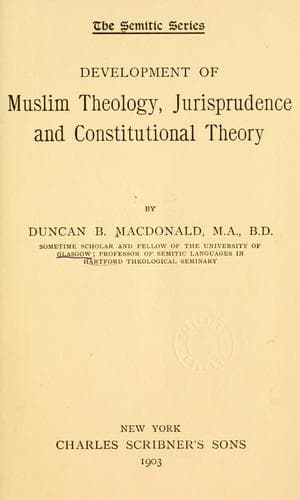
Development of Muslim Theology, Jurisprudence, and Constitutional TheoryMacDonald, Duncan Black
ReligionIslamic
Development of Muslim Theology, Jurisprudence, and Constitutional Theory
MacDonald, Duncan Black
Constitutional law (Islamic law); Islam -- Doctrines -- History; Islam and state -- History; Islamic law -- History
All his predecessors he joys in correcting, but his especial _bête
noire_ is al-Ghazzali. With him it is war on life or death. He has two
good causes. One is al-Ghazzali’s “Destruction of the Philosophers;”
of it, Ibn Rushd, in his turn, writes a “Destruction.” This is a
clever, incisive criticism, luminous with logical exactitude, yet
missing al-Ghazzali’s vital earnestness and incapable of reaching his
originality. But al-Ghazzali had not only attacked the philosophers; he
had also spread the knowledge of their teachings and reasonings, and had
said that there was nothing esoteric and impossible of grasp in them for
the ordinary mind. He had thus assailed the fundamental principles of the
Muwahhid system. Against this, Ibn Rushd wrote the tractates spoken of
above. They were evidently addressed to the educated laity; not to the
ignorant multitude, but to those who had already read such books as those
of al-Ghazzali and been affected by them, yet had not studied philosophy
at first hand. That they were not intended for such special students is
evident from the elaborate care that is taken in them to conceal, or,
if that were not possible, to put a good face upon obnoxious doctrines.
Thus, his philosophy left no place in reality for a system of rewards
and punishments or even for any individual existence of the soul after
death, for a creation of the material world, or for a providence in the
direct working of the supreme being on earth. But all these points are
involved or glossed over in these tractates.
Further, it is plain that their object was to bring about a reform
of religion in itself, and also of the attitude of theologians to
students of philosophy. In them he sums up his own position under four
heads: _First_, that philosophy agrees with religion and that religion
recommends philosophy. Here, he is fighting for his life. Religion is
true, a revelation from God; and philosophy is true, the results reached
by the human mind; these two truths cannot contradict each other. Again,
men are frequently exhorted in the Qur’an to reflect, to consider, to
speculate about things; that means the use of the intelligence, which
follows certain laws, long ago traced and worked out by the ancients. We
must, therefore, study their works and proceed further on the same course
ourselves, _i.e._, we must study philosophy.
_Second_, there are two things in religion, literal meaning and
interpretation. If we find anything in the Qur’an which seems externally
to contradict the results of philosophy, we may be quite sure that
there is something under the surface. We must look for some possible
interpretation of the passage, some inner meaning; and we shall certainly
find it.
[Sidenote: THE MULTIFORM TRUTH]
Public-domain text, read in full here on John Shaqi.
Reviews
Reviews
No reviews yet
Be the first to share your thoughts on this work.
Elsewhere in the archive
Join the Discussion
Join the discussion
Sign in to leave a comment or review.
Sign InorCreate an account