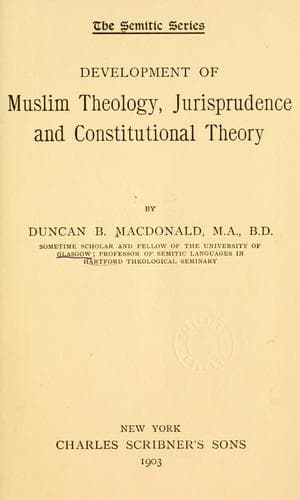
Development of Muslim Theology, Jurisprudence, and Constitutional TheoryMacDonald, Duncan Black
ReligionIslamic
Development of Muslim Theology, Jurisprudence, and Constitutional Theory
MacDonald, Duncan Black
Constitutional law (Islamic law); Islam -- Doctrines -- History; Islam and state -- History; Islamic law -- History
_Third_, the literal meaning is the duty of the multitude, and
interpretation the duty of scholars. Those who are not capable of
philosophical reasoning must hold the literal truth of the different
statements in the Qur’an. The imagery must be believed by them exactly
as it stands, except where it is absolutely evident that we have only
an image. On the other hand, philosophers must be given the liberty
of interpreting as they choose. If they find it necessary, from some
philosophical necessity, to adopt an allegorical interpretation of any
passage or to find in it a metaphor, that liberty must be open to them.
There must be no laying down of dogmas by the church as to what may
be interpreted and what may not. In Ibn Rushd’s opinion, the orthodox
theologians sometimes interpreted when they should have kept by the
letter, and sometimes took literally passages in which they should have
found imagery. He did not accuse them of heresy for this, and they should
grant him the same liberty.
_Fourth_, those who know are not to be allowed to communicate
interpretations to the multitude. So Ali said, “Speak to the people of
that which they understand; would ye that they give the lie to God and
His messenger?” Ibn Rushd considered that belief was reached by three
different classes of people in three different ways. The many believe
because of rhetorical syllogisms (_khitabiya_), _i.e._, those whose
premises consist of the statements of a religious teacher (_maqbulat_),
or are presumptions (_maznunat_). Others believe because of controversial
syllogisms (_jadliya_), which are based on principles (_mashhurat_) or
admissions (_musallamat_). All these premises belong to the class of
propositions which are not absolutely certain. The third class, and by
far the smaller, consists of the people of demonstration (_burhan_).
Their belief is based upon syllogisms composed of propositions which are
certain. These consist of axioms (_awwaliyat_) and five other classes of
certainties. Each of these three classes of people has to be treated in
the way that suits its mental character. It is wrong to put demonstration
or controversy before those who can understand only rhetorical reasoning.
It destroys their faith and gives them nothing to take its place. The
case is similar with those who can only reach controversial reasoning
but cannot attain unto demonstration. Thus Ibn Rushd would have the
faith of the multitude carefully screened from all contact with the
teachings of philosophers. Such books should not be allowed to go into
general circulation, and if necessary, the civil authorities should step
in to prevent it. If these principles were accepted and followed, a
return might be looked for of the golden age of Islam, when there was no
theological controversy and men believed sincerely and earnestly.
Public-domain text, read in full here on John Shaqi.
Reviews
Reviews
No reviews yet
Be the first to share your thoughts on this work.
Elsewhere in the archive
Join the Discussion
Join the discussion
Sign in to leave a comment or review.
Sign InorCreate an account