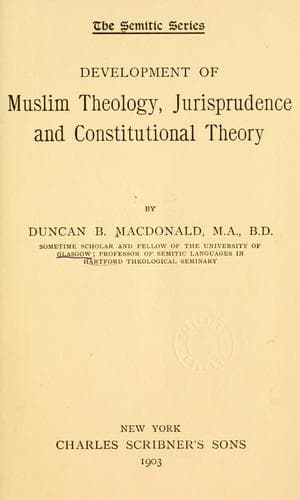
Development of Muslim Theology, Jurisprudence, and Constitutional TheoryMacDonald, Duncan Black
ReligionIslamic
Development of Muslim Theology, Jurisprudence, and Constitutional Theory
MacDonald, Duncan Black
Constitutional law (Islamic law); Islam -- Doctrines -- History; Islam and state -- History; Islamic law -- History
On this last paragraph it is worth noticing that its threefold
distinction is “conveyed” by Ibn Rushd from a little book belonging to
al-Ghazzali’s later life, after he had turned to the study of tradition,
_Iljam al-Awamm an ilm al-kalam_, “The reining in of the commonalty from
the science of kalam.”
Such was, practically, the end of the Muslim Aristotelians. Some
flickers of philosophic study doubtless remained. So we find a certain
Abu-l-Hajjaj ibn Tumlus (d. 620) writing on Aristotle’s “Analytics,”
and the tractates of Ibn Rushd described above were copied at Almeria
in 724. But the fate of all Muslim speculation fell, and this school
went out in Sufiism. It was not Ibn Rushd that triumphed but Ibn Tufayl,
and that side of Ibn Tufayl which was akin to al-Ghazzali. From this
point on, the thinkers and writers of Islam become mystics more and
more overwhelmingly. Dogmatic theology itself falls behind, and of
philosophical disciplines only formal logic and a metaphysics of the
straitest scholastic type are left. Philosophy becomes the handmaid of
theology, and a very mechanical handmaid at that. It is only in the
schools of the Sufis that we find real development and promise of life.
The future lay with them, however dubious it may seem to us that a future
in such charge must be.
[Sidenote: IBN ARABI]
The greatest Sufi in the Arabic-speaking world was undoubtedly Muhyi
ad-Din ibn Arabi. He was born in Murcia in 560, studied _hadith_ and
_fiqh_ at Seville, and in 598 set out to travel in the East. He wandered
through the Hijaz, Mesopotamia and Asia Minor, and died at Damascus in
638, leaving behind him an enormous mass of writings, at least 150 of
which have come down to us. Why he left Spain is unknown; it is plain
that he was under the influence of the Muwahhid movement. He was a
Zahirite in law; rejected analogy, opinion, and _taqlid_, but admitted
agreement. His attachment to the opinions of Ibn Hazm especially was very
strong. He edited some of that scholar’s works, and was only prevented by
his objections to _taqlid_ from being a formal Hazmite. But with all that
literalness in _fiqh_, his mysticism in theology was of the most rampant
and luxurious description. Between the two sides, it is true, there
existed a connection of a kind. He had no need for analogy or opinion or
for any of the workings of the vain human intelligence so long as the
divine light was flooding his soul and he saw the things of the heavens
with plain vision. So his books are a strange jumble of theosophy and
metaphysical paradoxes, all much like the theosophy of our own day. He
evidently took the system of the mutakallims and played with it by means
of formal logic and a lively imagination. To what extent he was sincere
in his claim of heavenly illuminings and mysterious powers it would be
hard to say. The oriental mystic has little difficulty in deceiving
himself. His opinions—so far as we can know them—may be briefly sketched
Public-domain text, read in full here on John Shaqi.
Reviews
Reviews
No reviews yet
Be the first to share your thoughts on this work.
Elsewhere in the archive
Join the Discussion
Join the discussion
Sign in to leave a comment or review.
Sign InorCreate an account