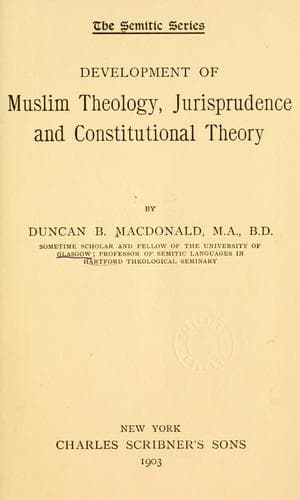
Development of Muslim Theology, Jurisprudence, and Constitutional TheoryMacDonald, Duncan Black
ReligionIslamic
Development of Muslim Theology, Jurisprudence, and Constitutional Theory
MacDonald, Duncan Black
Constitutional law (Islamic law); Islam -- Doctrines -- History; Islam and state -- History; Islamic law -- History
as follows: The being of all things is God: there is nothing except Him.
All things are an essential unity; every part of the world is the whole
world. So man is a unity in essence but a multiplicity in individuals.
His anthropology was an advance upon that of al-Ghazzali toward a more
unflinching pantheism. He has the same view that the soul of man is a
spiritual substance different from everything else and proceeding from
God. But he obliterates the difference of God and makes souls practically
emanations. At death these return into God who sent them forth. All
religions to Ibn Arabi were practically indifferent; in them all the
divine was working and was worshipped. Yet Islam is the more advantageous
and Sufiism is its true philosophy. Further, man has no free-will; he is
constrained by the will of God, which is really all that exists. Nor is
there any real difference between good and evil; the essential unity of
all things makes such a division impossible.
[Sidenote: IBN SAB‘IN]
The last of the Muwahhid circle with whom we need deal—and, perhaps,
absolutely the last—is Abd al-Haqq ibn Sab‘in. He was as much a mystic as
Ibn Arabi, but was apparently more deeply read in philosophy and did not
cast his conceptions in so theological and Qur’anic a mould. He, too, was
born in Murcia about 613, and must very early have founded a school of
his own, gathered disciples round him and established a wide reputation.
High skill in alchemy, astrology, and magic is ascribed to him, which
probably means that he claimed to be a _wali_, a friend of God, gifted
with miraculous powers. He is accused of posing as a prophet, although
in orthodox Islam Muhammad is the last and the seal of the prophets. But
against this, it may be said that he had no need of the actual title,
“prophet”; many mystics held—heretically, it is true—that the _wali_
stood higher than the prophet, _nabi_ or _rasul_. He had evidently
besides this a more solid reputation in philosophy, as is shown by his
correspondence with Frederick II, the great Hohenstaufen (d. 1250 A.D.).
The story is told on the Muslim side only, but has _vraisemblance_ and
seems to be tolerably authentic. According to it, Frederick addressed
certain questions in philosophy—on the eternity of the world, the nature
of the soul, the number and nature of the categories, etc.—to different
Muslim princes, begging that they would submit them to their learned
men. So the questions came to ar-Rashid, the Muwahhid (reg. 630-640),
addressed to Ibn Sab‘in as a scholar whose reputation had reached even
the Sicilian court. Ar-Rashid passed them on; Ibn Sab‘in accepted the
commission with a smile—this is the Muslim account—and triumphantly and
contemptuously expounded the difficulties of the Christian monarch and
student. In his replies he certainly displays a very complete and exact
knowledge of the Aristotelian and neo-Platonic systems, and is far less
a blind follower of Aristotle than is Ibn Rushd. But his schoolmasterly
Public-domain text, read in full here on John Shaqi.
Reviews
Reviews
No reviews yet
Be the first to share your thoughts on this work.
Elsewhere in the archive
Join the Discussion
Join the discussion
Sign in to leave a comment or review.
Sign InorCreate an account